How Long Does Chinese Incense Burn? The "One Stick" Clock
Share
There's a phrase 一炷香的时间, the time of one stick of incense, that gets used the way we'd say "give me a sec" or "back in a bit", was never a precise unit. You hear it in martial arts novels as a countdown before a duel. Monks used it to structure a day of sitting. Night watchmen used it to know when their shift was up.
Depending on the source it means 30 minutes, a full hour, or "somewhere between 15 minutes and an hour." All three answers are defensible, because there was never a standard. A stick was as long as the person making it decided to make it.
Chan Buddhist meditation halls come closest to a working convention: historical accounts of "sitting incense" (坐香) describe a stick as 30 to 50 minutes, varying by monastery.
Here are the ranges you'll actually see on a shelf today:
| Stick type | Typical length | Approximate burn time |
|---|---|---|
| Short / travel stick | 4–7 in (10–18 cm) | 10–25 min |
| Thin bamboo-core stick | 8–11 in (20–28 cm) | 20–40 min |
| Standard stick (bamboo core) | 11–12 in (28–30 cm) | 30–50 min |
| Solid stick, no core | 8–12 in (20–30 cm) | 30–60 min |
| Long temple stick | 12–16 in (30–40 cm) | 60 min or more |
One language note, since it trips people up. The character is 炷 (zhù), the classifier for something lit and burning. 柱 means "pillar." If you see 一柱香 online, it is a typo, though a very common one.
Three things move that number
Length and thickness. The obvious one. A 4-inch stick and a 16-inch stick are not doing the same job.
Bamboo core vs. solid. A bamboo-core stick, the Indian-style "joss stick" with bare bamboo at the base, burns faster and hotter because the bamboo itself feeds the ember along. A solid stick, the East Asian norm and what most Chinese-style incense is, burns slower and more evenly, and skips the faint bamboo note.
Moving air. A draft feeds the ember and shortens the burn. Still air lets a stick smolder at its own pace. Same stick, same room, different day, and you can get a ten-minute spread.
That last one is why nobody should sell you incense as a stopwatch.
Why incense became a clock
China had serious timekeeping hardware early: bronze water clocks, sundials, and by the Song dynasty, water-driven astronomical towers. They were expensive and heavy, and a sundial is useless at night or in bad weather.
Incense was cheap, portable, and worked in the dark.
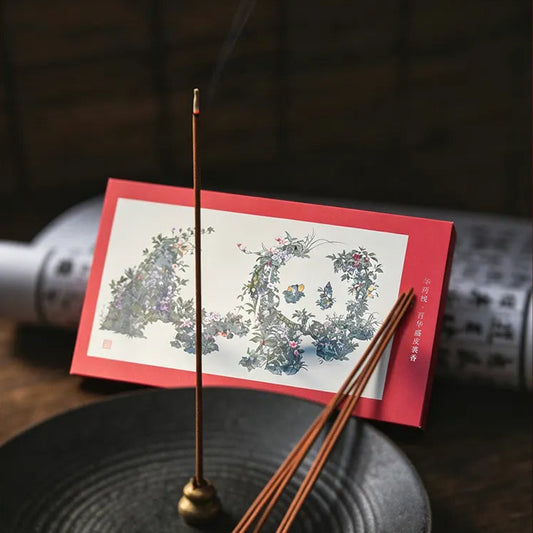
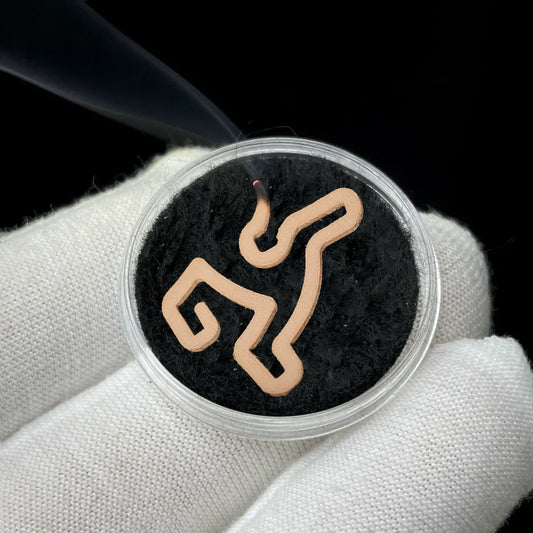
The most elegant version was the incense seal (香篆, also called 印香 or 百刻香). You press a wooden or bronze mold carved with a continuous pattern into a bed of ash, fill the groove with powdered incense, lift the mold away, and light one end. The fire walks the groove like a fuse.
Hong Chu's Song dynasty Xiang Pu (《香谱》, "Treatise on Incense") describes seals whose pattern followed the twelve double-hours, divided into one hundred marks, so that one burning lasted a full day and night.
There is a good origin story behind it. A Song-era stone inscription records that in 1073, during a drought severe enough to dry up wells and springs, an official waiting out a posting began making hundred-mark incense seals to mark dawn and dusk. When the water ran out, they switched to fire.
By the twelfth century the practice supported a trade. The Song memoir Dreaming of Splendor (《梦梁录》) describes specialists in Hangzhou who pressed fresh seals for households and collected a monthly fee.
Once you have a predictable burn, you can hang things off it. Literally. Night watchmen's sticks (更香) were marked with graduations and sometimes coiled so one piece burned for days, with small metal balls hung on threads at set points. When the fire reached a thread, the thread burned through, the ball dropped into a metal pan below, and it clanged. An alarm clock that works while you are asleep.
The Yuan astronomer Guo Shoujing, the same man who reformed the imperial calendar, built versions enclosed in a cabinet or a folding screen (柜香漏 and 屏风香漏). He did not do it for looks. A closed box has steadier air, and steadier air means a steadier burn.
The part nobody mentions: timekeeping incense was never the good stuff
This is where the romantic version gets it wrong. The incense that kept time was almost without exception not made from expensive materials, and that was a design choice, not an oversight.
A 24-hour seal uses too much of it. Agarwood and sandalwood were imported luxuries, priced by weight, the kind of thing a Song poet would write a whole poem about receiving as a gift. Burning that around the clock to find out what time it was would be like fuelling a furnace with perfume.
Precious resin is a bad clock. This is the counterintuitive one. High-grade agarwood is dense, oily, and wildly variable in resin content from batch to batch. It burns unevenly, it sputters, and it can drown its own ember. Beautiful to smell, unreliable to measure. A clock wants the opposite quality: repeatability.
Different jobs, different sticks. When Tang and Song literati gathered to compare and judge fragrances, a real pastime with its own etiquette, they were smelling agarwood, sandalwood, borneol, musk. The monastery's hundred-mark seal was doing shift work. One was the object of attention. The other was a ruler that happened to smell nice.
That split shows up in how a stick is built. Traditional incense has always been three things: the aromatic material, a combustible wood powder filler (fir or pine), and a binder, classically elm bark powder. The filler tempers a scent that would otherwise be overwhelming and helps the stick burn. The binder gives it the toughness to be coiled, marked, and hung with metal weights without snapping.
Put another way: the aromatics were the part you could vary. The filler and the binder were what made the clock work.
You can see the same split on a shelf today. A cheap dipped bamboo stick is built to throw scent fast and finish fast. A dense, solid, hand-blended stick is built to burn slow and even. Same two jobs, a thousand years apart.
Shop by what you're actually doing
Burn length is the most underrated thing to shop by, because it decides what a stick is for.
- 10–20 minutes. A short morning sit, a reset between meetings, airing out a room before someone comes over.
- 30–45 minutes. The default. One deep work block, a long bath, dinner cooking.
- 60 minutes or more. A full reading session, a longer practice, an evening that isn't going anywhere.
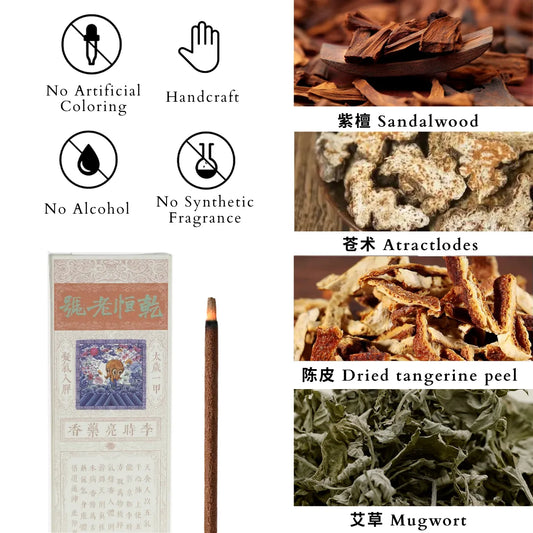
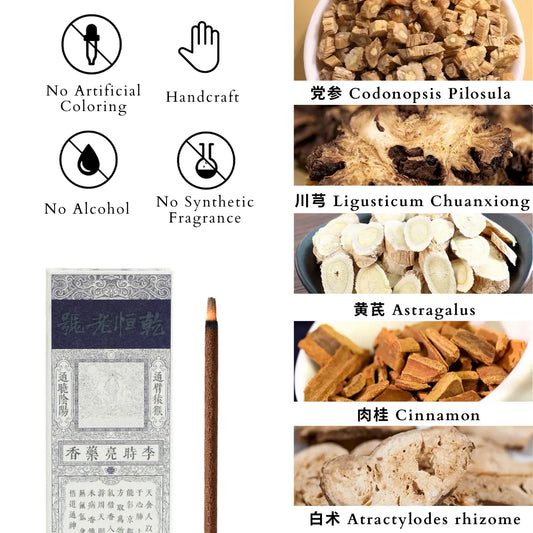
Our sticks are He-xiang, blended from Chinese botanicals, and they are made the way that second category always was: the formula is built around how it smells, not around calibrating a burn rate. Two practical consequences. They burn slow and even, because there is no bamboo core racing the ember along. And they are honest about not being a stopwatch, so a stick is roughly the shape of a half hour, plus or minus whatever your room is doing.
If you want to use one as a timer anyway, do what the monasteries did. Light it, stop looking at the clock, and let the stick tell you when you are done.
Shop traditional Chinese incense sticks → · read more about how He-xiang is blended →
If you want to use one as a timer anyway, do what the monasteries did: light one, stop looking at the clock, and let the stick tell you when you're done.
Burn safely
Never leave a burning stick unattended. Use a holder that catches ash, on a surface that will not scorch. Keep it away from curtains, paper, pets, and kids, and give the room some air. This is an open flame designed to keep going after you stop paying attention to it.
Sources
- Beijing Municipal Cultural Heritage Bureau (北京市文物局), 中国古代时辰香计时器具浅谈 (2015). link
- Liu Yun, 中国古代生活用香的风俗考, China Folklore Society (中国民俗学会). link
- Incense clock, Wikipedia. link
- China Daily language column, "一炷香时间"是多久? (2021). link
- People's Daily Online, "十二时辰"简史 (2019). link
- Ke Pu Zhong Guo (科普中国), 熏香. link
- ShaolinMart, How Long Does an Incense Stick Burn and What Changes the Time. link
- Traditional incense-making process references (aromatic + wood powder + elm bark binder) — industry-published, not peer-reviewed. link