Chinese Herbal Incense vs Japanese Incense: What’s the Difference?
If you are new to traditional incense, Chinese and Japanese incense can look remarkably similar.
Both have long histories. Both make extensive use of woods, resins, herbs, and other natural aromatic materials. Both developed alongside Buddhist and East Asian cultural traditions, and both can be remarkably subtle when made well.
But they don't always ask you to experience fragrance in the same way.
A useful distinction is not simply Chinese incense versus Japanese incense, or even blended incense versus single-material incense. It is this: What is the maker asking you to notice?

Some incense invites you to pay close attention to the character of a particular aromatic material. Other incense is built around the relationship between several materials—the way woods, herbs, flowers, and resins change one another when they become a single formula.
Traditional Chinese He Xiang (合香) belongs strongly to the second tradition.
Japanese incense includes both single-material and blended styles, but its fragrance culture also developed a particularly sophisticated practice of appreciating subtle differences in aromatic woods and compositions.
Neither approach is better.
They simply give you different ways to listen to incense.
The short answer
| Chinese Herbal Incense | Japanese Incense | |
|---|---|---|
| A common starting point | A formulated combination of aromatic materials | A specific aromatic material or a carefully developed fragrance composition |
| Traditional emphasis | Harmony between materials and the finished formula | Subtle appreciation of fragrance, including precious woods |
| Materials | Woods, roots, herbs, flowers, resins and spices may be combined | Sandalwood, agarwood, herbs, resins and other aromatic materials |
| Fragrance experience | Often layered, botanical and evolving | Often restrained, precise and nuanced |
| Coreless sticks | Found in traditional and modern Chinese incense | Very common |
| Ritual culture | Incense appreciation, tea, scholarship, religious and household use | Incense appreciation, kōdō, Buddhist practice and broader Japanese arts |
| Best starting point if you like... | Complex formulas and botanical, earthy, woody aromas | Subtle woods and refined fragrance profiles |
This is a guide to tendencies, not rules. There is enormous variation within both traditions.
What is Chinese herbal incense?
The phrase Chinese herbal incense can refer to several different kinds of traditional Chinese incense, so it helps to be precise.
Chinese incense is not one recipe, one fragrance style, or even one historical tradition.
There are single-material incenses made primarily around woods such as sandalwood or agarwood. There are also compound formulas in which numerous aromatic materials are deliberately combined.
One of the most important ideas within this latter tradition is He Xiang (合香).
The word he means to combine, join, or bring together, while xiang refers to fragrance or incense.
The important idea is not simply that a formula contains many ingredients.
It is that the ingredients are selected for how they work together.
Traditional Chinese incense-making can involve selecting materials, processing them, grinding them, proportioning them, combining them, resting or aging the mixture, and shaping the finished incense. Traditional craft descriptions emphasize that formulation and preparation are as important as the raw materials themselves.
That is why two incense sticks can contain some of the same ingredients and still smell completely different.
The formula changes the relationship between them.
He Xiang is closer to cooking than mixing perfume
Imagine a kitchen.
- Sandalwood might provide the warm foundation.
- A resin might add sweetness and depth.
- A root or herb might introduce something dry, earthy, or aromatic.
- A flower might lift the composition.
The goal is not for each ingredient to announce itself separately.
The goal is for the ingredients to become a coherent whole.
That is the idea behind He Xiang at its most useful.
And it explains something that first-time buyers often notice about traditional Chinese herbal incense: the ingredient list does not necessarily tell you exactly what the finished incense will smell like.
The formula matters.
What is Japanese incense?
While Japanese incense traditions were influenced by earlier incense practices from China and other parts of Asia, Japanese incense developed its own distinctive fragrance culture over centuries, with important connections to Buddhism and to the appreciation of aromatic woods.
Commercial Japanese incense can contain combinations of woods, herbs, resins, and other aromatic materials, while the broader culture of kōdō (香道) places particular importance on attentive appreciation of fragrance. The Metropolitan Museum of Art traces the development of kōdō as a formalized art in Japan, especially during the Edo period.
One especially important aspect is the appreciation of precious aromatic woods such as agarwood and sandalwood.
Instead of asking only: What fragrance has been created? the experience can become: What is this particular material revealing?
Modern Japanese incense makers also work with many different scent profiles and formulations. Japanese manufacturers have adapted traditional incense for contemporary homes, including developing lower-smoke varieties for smaller living spaces.
Chinese vs. Japanese incense: the real difference
The easiest comparison is not complex versus simple.
It is relationship versus individual character.
Chinese herbal incense often asks:
How do these materials become something greater together?
Japanese incense often invites:
What can I discover in this fragrance?
Those approaches can overlap.
A Chinese incense may highlight one exceptional agarwood.
A Japanese incense may be a carefully constructed blend.
But as a starting point for understanding the traditions, the distinction is useful.
| Fragrance experience | Chinese Herbal Incense | Japanese Incense |
| First impression | Often botanical, warm, woody, earthy or layered | Often restrained, clean, woody, resinous or softly floral |
| As it burns | Different materials may become more apparent at different stages | Subtle changes in the main aromatic character can become easier to notice |
| Complexity | Often comes from the interaction of ingredients | Can come from either the material itself or a refined composition |
| What to pay attention to | Balance, layers, transition, relationship | Nuance, texture, clarity, individual character |
| Overall feeling | Often more like discovering a composition | Often more like listening closely to a fragrance |
These descriptions are intentionally broad.
A high-quality Chinese incense can be extremely subtle.
A Japanese incense can be rich and complex.
Country of origin alone does not determine fragrance quality.
The history is connected, not separate
It is tempting to tell the story as though Chinese incense and Japanese incense developed independently.
They did not.
Incense, aromatic materials, Buddhist practices, objects, and cultural techniques moved across East Asia for centuries. Museums today preserve physical evidence of these connections: Chinese incense objects from the Song period were preserved in Japan, while Japanese incense vessels and practices developed their own forms over time.
Japan did not simply copy Chinese incense.
It received and transformed influences into its own cultural practices.
That distinction matters.
The history is better understood as: shared roots → transmission → adaptation → distinct traditions
rather than: China versus Japan.
This is also why comparing the two can be so interesting.
You are not comparing two unrelated inventions.
You are looking at two fragrance cultures that share parts of an older East Asian history and then developed their own ways of working with scent.
What does Chinese herbal incense actually smell like?
This is where descriptions such as "Chinese incense smells herbal" become too vague to be useful.
Traditional Chinese formulas can include very different combinations of materials.
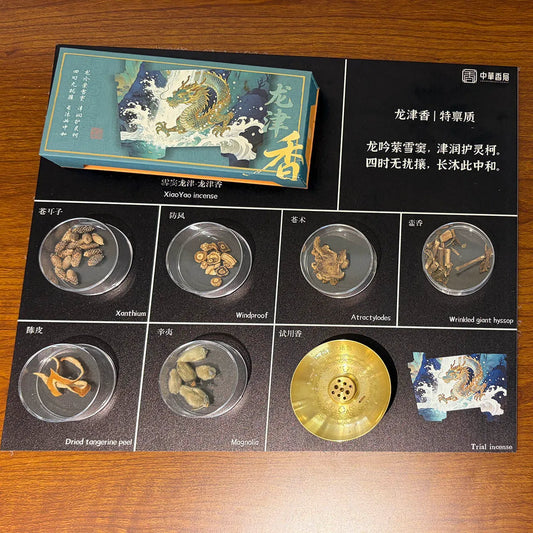
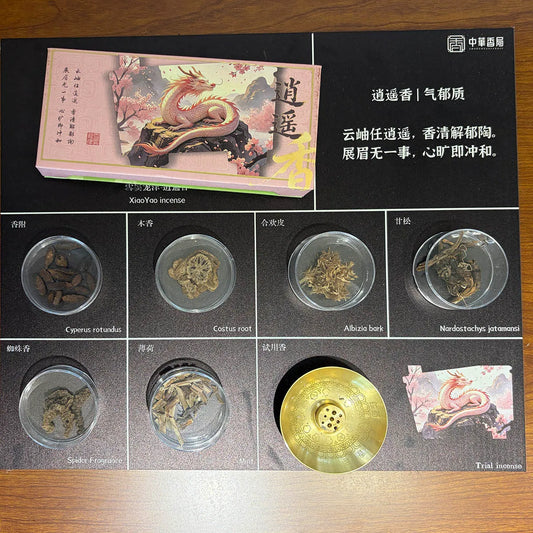
Depending on the formula, you may encounter:
- warm sandalwood
- dark agarwood
- dry roots
- aromatic herbs
- sweet resins
- soft florals
- spices
- earthy or medicinal-botanical notes
The important characteristic is often movement.
The opening may not smell exactly like the aroma after ten or twenty minutes.
One material may be obvious at first and then recede. Another may become warmer as the stick continues to burn.
This is one reason people who enjoy traditional Chinese incense sometimes describe it as layered rather than simply "strong."
A Reddit discussion from an experienced incense user is useful here: people comparing Chinese and Japanese incense describe Chinese examples they have tried as delicate, complex, and sometimes less sweet than Japanese examples. Other users specifically mention enjoying Chinese incense because of its gentle, layered character. These are personal observations, not rules—but they reflect the kind of variation worth exploring.
What does Japanese incense smell like?
Japanese incense is equally difficult to reduce to one scent.
You may encounter:
- dry sandalwood
- creamy sandalwood
- dark agarwood
- soft florals
- resinous warmth
- green or tea-like notes
- subtle spice
- modern fragrance compositions
The difference is often less about the ingredient list and more about how clearly the fragrance is presented.
A good Japanese incense can make you notice small differences that would disappear inside a louder composition.
This is part of the appeal for people who enjoy incense as an exercise in attention.
You do not necessarily need a dramatic fragrance.
You need enough detail to keep listening.
What about bamboo cores?
This is one area where people shopping for incense in North America often notice an obvious physical difference.
Many Japanese incense sticks are coreless: the aromatic incense material itself forms the stick.
Chinese incense is more varied. Traditional Chinese incense includes both coreless and bamboo-core forms, depending on the type and maker.
So it would be inaccurate to say:
Japanese incense = coreless
Chinese incense = bamboo core
The more useful distinction is:
coreless incense burns without a bamboo splint running through the center.
For people sensitive to the smell of burning bamboo or who simply prefer the aroma of the incense material itself, coreless sticks can be particularly appealing.
This is also one reason some North American incense users who discover traditional Chinese sticks become interested in them. In a 2026 Reddit discussion, a user specifically described a thin, coreless Chinese incense as ideal for a small dorm room because of its low smoke and clean-burning character. All incense sticks from Panda Incense are coreless and low smoke.

But coreless does not automatically mean "better."
The materials, formulation, processing, burn temperature, and amount of smoke still matter.
Which one should you try?
There is no winner here.
Instead, think about what you want to pay attention to.
Try Chinese herbal incense if you...
Enjoy layered fragrance
You like aromas that unfold rather than staying on one obvious note.
Want to explore botanical materials
Roots, woods, herbs, flowers and resins interest you as ingredients in their own right.
Like the idea of formula
You are curious about what happens when several aromatic materials are deliberately brought together.
Want to explore Chinese fragrance culture
You are interested in a tradition that includes incense appreciation, tea culture, scholarship, religious practice, household fragrance, and compound incense-making.
Try Japanese incense if you...
Prefer subtle fragrance
You would rather notice a quiet change than have the room immediately filled with scent.
Love sandalwood or agarwood
You enjoy comparing the character of precious aromatic woods.
Like minimalism
You prefer a fragrance experience that feels clean, restrained, and precise.
Want to explore kōdō
You are interested in incense as a formal practice of attention and appreciation.
And there is no reason to choose only one.
Many serious incense enthusiasts use both.
In fact, Reddit discussions from experienced collectors often move between Japanese, Chinese, Tibetan, and Indian incense rather than treating them as competing categories.
How to tell whether Chinese herbal incense is actually well made
This may be more useful than any "Chinese vs. Japanese" ranking.
Because Chinese incense is not automatically high quality simply because it is traditional or herbal.
Look beyond the country printed on the box.
Look at the ingredients
Does the maker explain what is actually in the incense?
"Natural fragrance" tells you very little.
A thoughtful ingredient list tells you much more.
Look at the construction
Is it coreless?
Does the stick have a consistent texture?
Does it burn steadily rather than producing excessive smoke?
Look at the fragrance
Does the scent smell like individual ingredients thrown together?
Or do the materials feel integrated?
Look at the maker
Can the brand explain its formulation, materials, and process?
The growing interest in Chinese incense on Reddit also reveals a problem: buyers often say they have difficulty finding reliable information about Chinese incense in Western markets, with many products available online but relatively little explanation of how they were made.
That lack of transparency is exactly why provenance and formulation matter.
Why Panda Incense makes Chinese herbal incense
Panda Incense focuses on a particular part of this larger Chinese tradition:
natural botanical incense built around traditional formulation rather than synthetic fragrance.
We are not trying to reproduce the Japanese incense experience.
And we are not trying to turn Chinese incense into a Western aromatherapy product.
Our approach is rooted in Chinese herbal incense—where woods, roots, flowers, resins, and other aromatic botanicals can be selected for how they work together.
That philosophy changes how we think about fragrance. We start with: "What does this combination of natural materials become when they are brought together?"
That is the part of Chinese incense culture we believe deserves more attention outside China.
Not because it is better than Japanese incense.
Because it is different—and it has been refined for generations.
At Panda Incense, we continue this tradition through incense designed for modern lifestyles:
- incense sticks for creating a peaceful home atmosphere
- incense bracelet/necklace inspired by wearable fragrance traditions


Chinese herbal incense vs. Japanese incense: the takeaway
If you prefer a single sentence:
Japanese incense can teach you to listen closely to fragrance; Chinese herbal incense can teach you to listen to the relationship between fragrances.
But don't take that as a rigid rule.
There are Japanese blends. There are Chinese single-material incenses. There are modern makers in both countries who borrow from different traditions.
The more you explore, the less useful strict categories become.
What remains useful is learning to notice: the material, the formulation, the smoke, the way the fragrance changes, and the intention behind the craft.
That is where incense becomes more interesting than simply "something that smells good."
Frequently Asked Questions
What is the main difference between Chinese herbal incense and Japanese incense?
The biggest difference is often the emphasis. Traditional Chinese compound incense places strong importance on formulation and the relationship between multiple aromatic materials, while Japanese incense culture is particularly known for refined appreciation of fragrance and precious woods. Both traditions include a wide range of incense styles.
What does He Xiang mean?
He Xiang (合香) refers to the traditional Chinese practice of combining different aromatic materials into a considered incense formula. The emphasis is on how the materials work together rather than simply using a larger number of ingredients.
Is Chinese herbal incense the same as Chinese incense?
Not exactly. "Chinese incense" is a broad category that includes many styles, including single-material incense, compound herbal incense, religious incense, and different regional traditions. Chinese herbal incense refers more specifically to incense made using botanical materials within a traditional herbal or compound formulation.
Is Japanese incense always made from one ingredient?
No. This is a common misconception. Japanese incense includes both single-material and blended fragrances. The tradition is broader than simply burning sandalwood or agarwood.
Is Chinese incense stronger than Japanese incense?
Not necessarily. Both can range from very subtle to quite noticeable. Strength depends more on the materials, formulation, manufacturing process, and amount burned than simply on whether the incense is Chinese or Japanese.
Is Chinese incense natural?
Some Chinese incense is made primarily from natural woods, herbs, resins, and other botanical materials, while commercial Chinese incense can vary considerably. The country of origin alone does not guarantee that a product contains no synthetic fragrance. Check the manufacturer's ingredient and formulation information.
Which is better, Chinese or Japanese incense?
Neither is objectively better. Japanese incense may appeal to people who enjoy subtle woods and refined fragrance, while Chinese herbal incense may appeal to people interested in layered botanical formulas and the tradition of He Xiang. Many incense enthusiasts enjoy both.
Why are Japanese incense sticks often coreless?
Many Japanese incense sticks are made without a bamboo splint, allowing the incense material itself to burn. Chinese incense also includes coreless traditions, so this is not an exclusively Japanese characteristic.
Does Chinese herbal incense smell medicinal?
It can, but it does not have to. Some traditional herbal materials have earthy, bitter, dry, or medicinal-botanical aromas, while other formulas can be warm, woody, sweet, floral, or resinous. The formula determines the final character.
Where should I start with Chinese herbal incense?
Start with a formula whose ingredient profile you understand and whose maker clearly explains how it is made. If you already enjoy Japanese sandalwood or agarwood incense, a Chinese herbal formula containing familiar woods can be an easy bridge into the tradition.