What Goes Into a Chinese Incense Stick: The Four Material Families
You pick up a box of incense and turn it over to read the label. A mass-market box gives you three vague words and a "fragrance" name. A box from a Chinese workshop working in the classical tradition gives you a list: roots, woods, resins, flowers, and occasionally something that stops you mid-read.
Classical practice sorts all of those materials into four scources: plants, resins, animal aromatics, and the mineral-and-metal group called jin shi (金石). This guide covers each family in turn, using the nine formulas of our Xuedou Dragon Stream line as the working examples. If you only want the short version of what each stick smells like, that lives on each product page. If you want to know why it smells that way, read on.
1. Plants (ben cao, 本草)
Whatever else is in the stick, most of it, by weight, is plant material. The classical sources, Xiang Cheng (《香乘》, Wen Lian, 1611) and the Song-dynasty formularies Chen Shi Xiang Pu (《陈氏香谱》) and Ming Xiang Pu (《名香谱》), name hundreds of aromatic plants and give each one a job. The jobs follow a structure called jun chen zuo shi (君臣佐使): chief, deputy, assistant, envoy. The chief carries the dominant note; deputies shape it; assistants steady it; envoys carry it into the smoke.
Different parts of the plant do different work: roots for depth, leaves for top notes, flowers for lift, fruits and seeds for warmth and fixative grip. That is how one formula can hold both the sharp green of a fresh leaf and the slow sweetness of a dried root in the same burn.
Two of our nine formulas lean hardest on plants, and they sit at opposite ends of the line.
Chang Su is the everyday stick, and it shows what a plant-led blend does when nothing shouts. Benzoin (安息香) sets the warm base; agarwood (沉香) sits underneath it, quiet and resinous; huanghuali (黄花梨) and patchouli (藿香) fill out the middle; licorice (甘草) and lysimachia foenum-graecum (零陵香) round the edges off. It is the stick you burn while doing something else.
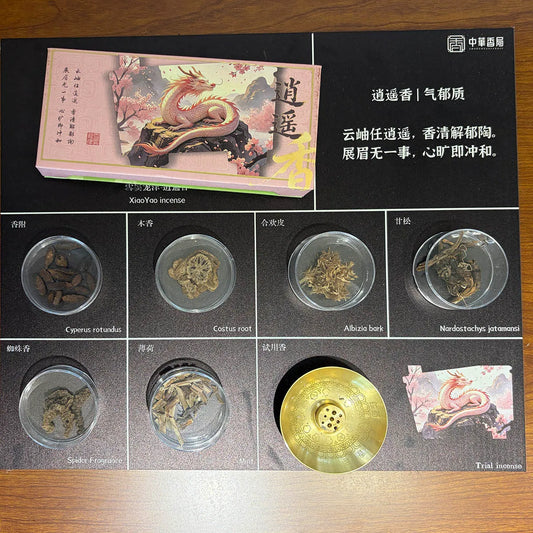
Xiao Yao runs the other direction: light, lifted, almost minty. Cyperus (香附) and costus root (木香) build the airy frame, nardostachys (甘松) and mimosa bark (合欢皮) warm it just enough, and field mint (薄荷) with valeriana jatamansi (蜘蛛香) leave the cool finish. This is the one for a bright room on a Sunday morning.
One plant material with an unusual source. Panda bamboo fiber (皮裘竹夜香), collected from panda keep's daily bamboo feed, refined over a 30-day cycl, is the base of our separate Piqiu incense line. Biologically it is pure plant fiber, and the full story of where it comes from is on the refined panda bamboo fiber page.
2. Resins (树脂)
Here is a fact you can test at home: light a resin-heavy stick, put it out after a minute, and the room will still carry the scent tomorrow. Resin is the dried sap of aromatic trees, sticky when fresh, hard when aged, and it evaporates so slowly that it becomes the base note of the whole burn. Classical formularies treat resins as their own family precisely because they behave differently in the fire: slower to open, lower to sit, longer to last.
The family includes agarwood (沉香), sandalwood (檀香), frankincense (乳香), myrrh (没药), benzoin (安息香), borneol (龙脑), and storax (苏合香).
Tong Qu is the most resin-forward of the nine. Frankincense and myrrh carry the base, cassia (官桂) and angelica sinensis (当归) warm the top of it, ligusticum (川芎) threads through the middle, and benzoin ties the burn together. Light it when you want a full room, not a corner.
Xu Yang uses resins as the backbone of a winter spice blend: cinnamon bark (肉桂) and clove (丁香) up front, mugwort (艾叶) and dried ginger (干姜) behind them, benzoin and lysimachia foenum-graecum (零陵香) holding the long finish. First cold morning of the year, this is the stick.
3. Animal-Derived Aromatics (动物香料)
The most famous incense material in Chinese history is one you will almost certainly never smell.
Musk (麝香), the secretion of the musk deer, was the most prized aromatic in classical Chinese incense, valued as a fixative and a top note, and it appears throughout Xiang Cheng and the Song formularies. Alongside it stood civet (灵猫香), ambergris (龙涎香) from the sperm whale, and shell-derived jia xiang (甲香), calcined and ground. These four carried warmth and endurance that plant materials could not match, which is exactly why the classical courts paid fortunes for them.
Most of these are now restricted or banned in modern commerce, like musk, civet, and ambergris. As a result, ethical sourcing rules and import regulations have moved commercial incense almost entirely toward plant, resin, mineral, and similar materials. Panda Incense does not use any animal-derived ingredient. Every material in our catalog is a plant, a natural tree resin, a mineral, or a plant fiber.
4. Minerals and Metals (金石)
Twelfth-century Kaifeng, the Northern Song court: an imperial formula recorded in Xiang Cheng volume 14 rolls finished incense pills in gold leaf: "以金箔为衣" (use gold leaf as the outer wrap). The recipe, Xuanhe Guifei Wang Shi Jin Xiang (宣和贵妃王氏金香), is attributed in the original to the Song recipe collection Shi Zhai Shou Yong Lu (《是斋售用录》). A neighboring formula in the same volume, Xuanhe Yu Zhi Xiang (宣和御制香), coats its pills instead with cinnabar: "以朱砂为衣". These are historical records of court expense and refinement — gold and cinnabar were never the aroma, they were the wrapping.
That is jin shi in one image. Ben Cao Gang Mu (《本草纲目》, Li Shizhen, 1578) groups the whole family (gold, silver, coral, realgar (雄黄), cinnabar (朱砂), calcite, gypsum) under a single heading, split between metals and gems (金玉) and stones (石). Cinnabar appears in both halves depending on its use.
It is also the family a modern maker handles most carefully. Cinnabar is a mercury compound, realgar an arsenic compound, and lead-bearing minerals appear in old recipes, all restricted under FDA and California Prop 65 heavy-metal rules. Panda Incense uses no metals and no heavy-metal minerals in any formula.
The single mineral we do use is amber, in Gan Lu, the quietest stick of the nine, built on osmanthus (桂花) and nardostachys (甘松) with amber (琥珀) giving the smoke a resinous warmth you notice more than you smell. This is real fossilized tree resin, not the "amber accord" of Western perfumery, which is a labdanum-and-vanilla construct with no amber in it at all. (Ben Cao Gang Mu files amber under wood, as aged pine resin; we follow the modern mineral view and place it here; either way, it is the same stone-warm material jewelers have worked for a thousand years.)
5. The maker
Every formula on this page was developed and blended by Li Shiliang, fifth-generation inheritor of 传统香制作技艺 (药香制作技艺), project Ⅷ-224, inscribed on China's fourth national list of intangible cultural heritage in 2014. In 2018 he was named a national-level representative inheritor.
- Full story → About the workshop and the inheritor.
- Production process → How the incense is actually made.
6. Quick reference: the nine incense sticks
This table is for comparing the nine formulas at a glance.
|
Stick |
Scent direction |
Main materials |
|
Chang Su Incense Stick |
Soft, even, all-purpose |
benzoin (安息香), agarwood (沉香), huanghuali (黄花梨), patchouli (藿香), licorice (甘草), lysimachia (零陵香) |
|
Xiao Yao Incense Stick |
Airy, lifted, mint-cool |
cyperus (香附), costus root (木香), mimosa bark (合欢皮), nardostachys (甘松), field mint (薄荷), valeriana (蜘蛛香) |
|
Xu Yang Incense Stick |
Warming spice, deep winter |
cinnamon bark (肉桂), clove (丁香), mugwort (艾叶), dried ginger (干姜), benzoin (安息香), lysimachia (零陵香) |
|
Gan Lu Incense Stick |
Cool, clean, still air |
osmanthus (桂花), nardostachys (甘松), lysimachia (金钱草), amber (琥珀), codonopsis (党参)*, polygala (远志) |
|
Fu Yao Incense Stick |
Grounded, steady, low-key |
cymbopogon (茅香), atractylodes (白术), angelica dahurica (白芷), nardostachys (甘松), patchouli (藿香), dried tangerine peel (陈皮) |
|
Qing Lan Incense Stick |
Dry, clear, damp-day |
atractylodes lancea (苍术), cymbopogon (茅香), sichuan pepper (花椒), cyperus (香附), kaempferia (山奈), dried tangerine peel (陈皮) |
|
Xian Yue Incense Stick |
Light, fresh, summer evening |
dragonhead (香青兰), field mint (薄荷), lysimachia (零陵香), patchouli (藿香), atractylodes (苍术), costus root (木香) |
|
Tong Qu Incense Stick |
Deep, full-bodied resin |
angelica sinensis (当归), cinnamomum cassia (官桂), frankincense (乳香), ligusticum (川芎), myrrh (没药), benzoin (安息香) |
|
Long Jin Incense Stick |
Cool, clear, menthol-eucalyptus character |
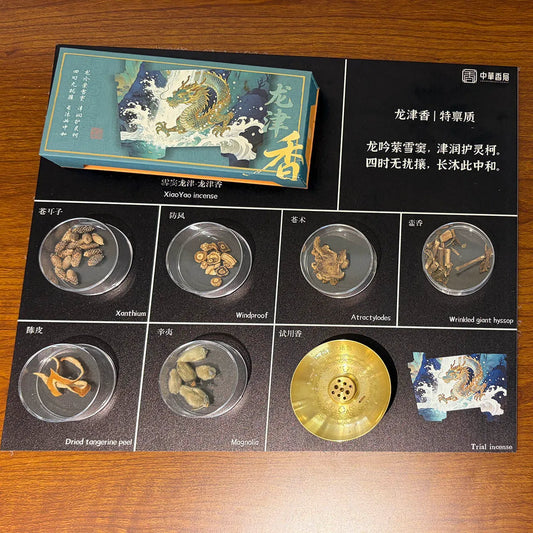
xanthium (苍耳子), magnolia flower (辛夷), saposhnikovia (防风), dried tangerine peel (陈皮), atractylodes (苍术), patchouli (藿香) |
The Xuedou Dragon Stream materials come from a Chinese herbal tradition that has historical medical roots. In the United States we sell these sticks as incense: for their scent, for the atmosphere they create, and for the cultural and craft story they carry.