Dampness in Chinese Medicine: How to Remove at Home
Share
The one-minute version. If the past week left you feeling heavy, puffy, and slow, you are in very large company. Nearly one in seven American adults reported bloating in the previous seven days, and more than half of them never sought care for it (Oh et al., Clinical Gastroenterology and Hepatology, 2022). Chinese medicine has a name for that cluster of sensations: dampness (湿, shi). It describes a pattern rather than a Western diagnosis, and this article will keep that line clear. What follows is what dampness means in the tradition, and why a pot of red beans is supposed to be cooked until it looks like wet sand. One practical warning: the two red beans at the Asian grocery are not the same bean, and the difference matters. Near the end, we show how the framework maps onto four incense blends we make, one for each pattern.
What dampness actually means
Chinese medicine counts six external influences that can unsettle a body, and dampness is the heavy one. Cold arrives fast and sharp. Dampness arrives slowly, sits low, and stays. The tradition describes it as sticky and lingering, which is why it is associated with problems that drag on instead of resolving.
The tradition sorts dampness into two sources. External dampness comes from the world: humid weather, a damp apartment, working in water, a long rainy season. Internal dampness is produced by the body itself, and it almost always traces back to the spleen.
The spleen in Chinese medicine is not the small organ your doctor means. It is a functional system in charge of transforming food and drink into usable material and moving that material where it needs to go. When this system is described as weak, fluids do not get moved properly. They pool. Over time that pooling is called dampness.
The kitchen drain is the comparison most practitioners reach for. Water keeps coming in, but nothing is moving out. It sits, it thickens, and eventually the room smells of it.
The signs the tradition associates with dampness include a heavy head, heavy limbs, a sense of fullness after eating, loose or sticky stools, a thick coating on the tongue, and a general dullness that rest does not fix. A person can have several of these and still have completely normal blood work. That is the situation dampness language was built for: a set of complaints that are real to the person experiencing them and hard to name in a standard exam.
To be clear about what this is: dampness is a traditional way of describing a group of symptoms together. It is not the same thing as water retention, swelling, or extra body water, even where the descriptions overlap. If you have genuine swelling, shortness of breath, or rapid weight change, that is a medical question and belongs with a doctor.
What the concept of obesity got passed down
The Huangdi Neijing, compiled more than two thousand years ago, describes three body types among heavier people: the fat person, the fleshy person, and the muscular person. The Suwen chapter on extraordinary diseases already connected excess weight to rich food, saying that the wealthy and noble suffer the ailments of fine grain and rich meat (Guangdong Provincial Administration of Traditional Chinese Medicine).
The Yuan dynasty physician Zhu Danxi went further in the Danxi Xinfa, writing that fat people tend to carry phlegm-dampness, and that the root is qi deficiency, because weak qi cannot move and transform, and so phlegm is produced. The Jingyue Quanshu repeats the formula: fat people tend to have qi deficiency and phlegm-dampness.
So the tradition does have a concept of obesity. It simply files it under a different cause than calories alone. The pattern it describes runs like this: the digestive system loses power, fluids stop moving, they thicken into phlegm-dampness, and that accumulates. The weight is treated as a downstream result, and the sluggish digestion is treated as the real problem.
That distinction changes the practical advice. If obesity were nothing but dampness, a pot of bean water would be the answer. If the root is a digestive system that has lost its drive, then the tools are regular warm meals, movement, sleep, and herbs that support digestion. The bean water is a small part of a larger picture.
Some kitchen herbs that do the work
The herbs used for dampness run to a long list, including poria cocos, atractylodes, dried tangerine peel, agastache, and eupatorium.
Fu ling (茯苓), Poria cocos. This is a fungus that grows on pine roots, and it is the quiet workhorse of the category. The tradition calls it sweet and neutral, and credits it with draining dampness while supporting the spleen. Modern research has looked at one of its traditional actions in animals. In a rat study, fractions extracted from the outer skin of the fungus increased urine output and raised sodium and chloride excretion, with no increase in potassium loss (Feng et al., Journal of Ethnopharmacology, 2013). The mechanism proposed in later work involves the kidney's water channels, the aquaporins that decide how much water gets reabsorbed before urine leaves the body. This profile is why classical texts treated fu ling as a gentle diuretic rather than a forceful one.
Yi ren (薏米), Coix seed or Job's tears. A grain used as both food and medicine, traditionally credited with strengthening the spleen and draining dampness. Researchers building a rat model of spleen deficiency with dampness found that the protein and polysaccharide fractions of coix seed regulated water transport, with effects showing up in aquaporin-related gene expression (PMC5471471).
Qian shi (芡实), euryale seed, and lian zi (莲子), lotus seed. These two work in the opposite direction. They are astringent, holding things in rather than pushing them out.
Draining alone would leave the system depleted, so the tradition pairs herbs that move fluid with herbs that hold it. One direction loosens, the other keeps. If you have ever wondered why a Chinese soup recipe lists five or six ingredients where one would seem to do, this is why.
The studies above were done in rats, at doses far higher than what a bowl of soup provides, using extracts rather than whole grain. They show that fu ling and coix seed can change how water moves through an animal body. The herbs are worth taking seriously, and not all the soups are treatment.
Why the beans get cooked to sand
Chinese cosmology divides time into twelve earthly branches, four of which are assigned to the earth element. Used in dating, they are chen, xu, chou, and wei (辰、戌、丑、未). Each carries a temperature and a moisture, and each maps to a season:
- Chou, the ox, sits at the end of deep winter. Its earth is frozen.
- Chen, the dragon, sits at the end of spring. Its earth is damp, the wet ground of a field in rain.
- Wei, the goat, sits at the end of summer. Its earth is parched and hot.
- Xu, the dog, sits at the end of autumn. Its earth is dry and warm.
Water cannot pool in sandy ground or warm dry ground. It drains through and it is gone. So how do we cook red beans for dampness in the correct way? Cook them until the beans break down completely, until the pot is a loose, grainy mash with no whole bean left. It is to turn the bean into dry soil. Dampness, the reasoning goes, cannot take root in sand.
Make the bean into sand, and the sand will not hold water.
Two kinds of red bean at the store
Walk into an Asian grocery in the United States and you will find two alike small red beans. They do different traditional jobs. Grab the wrong one and the pot never reaches sand.
|
|
The round, glossy one |
The slender, darker one |
|
Label on the package |
Red bean or adzuki |
Chi xiao dou or rice bean |
|
Species |
Vigna angularis |
Vigna umbellata |
|
What it does in the pot |
Breaks down into soft, starchy sand, quickly |
Stays firm even after an overnight soak (CCTV report on the two beans) |
|
Traditional job |
An eating bean: desserts, congee, gentle support for digestion |
The draining bean of the classical formulas, the one paired with coix seed |
One complication makes the labels unreliable. The official pharmacopoeia entry for chi xiao dou accepts the dried seeds of either species (Tencent Medical Dictionary entry). A package marked chi xiao dou may hold the slender rice bean, or it may hold ordinary adzuki. So read the beans, and read their shape, before you read the label.
If you want the pot of sand from the earlier section, pick the round, bright, glossy beans. If you want the traditional draining preparation, pick the slender ones, plan an overnight soak, and expect a long simmer.
How to make it
One recipe, two versions. The default uses the round adzuki bean, because it is the easiest to find and it reaches sand quickly. The classical variant at the end swaps in the slender chi xiao dou, the bean of the old formulas.
The default pot: round adzuki plus coix seed
- Measure one part adzuki beans and one part coix seed. Rinse both.
- Optional but worth doing: dry-toast the coix seed in a pan for a few minutes first. This is a common household practice meant to soften its cooling nature, particularly for people who run cold.
- Put everything in a pot with plenty of water. Bring it to a boil, then drop to a low simmer.
- Cook until the beans have fully broken down and the liquid turns cloudy and grainy. Keep going until nothing whole remains. That is the stage the old instruction points at, and the round bean gets there fast.
- Drink the liquid, eat the solids, or both. Most household practice uses this two or three times a week rather than daily.
The classical variant: slender chi xiao dou
Swap the round bean for the slender one and change two things. Soak it overnight, because it resists softening. Then expect a long simmer, an hour or more, before it breaks down. The result is earthier and less sweet, and it is the version closest to the classical draining preparation.
The honest limits
Dampness is a traditional framework. It overlaps with things modern medicine recognizes, including bloating and fluid retention, and it is not a substitute for a diagnosis. If swelling, bloating, or fatigue is persistent, new, or severe, see a doctor. Some of the conditions that produce those symptoms need real treatment.
Red bean and coix seed water is food, and it is not a weight loss product. Gentle does not mean unlimited. Fu ling has a documented diuretic action, which means it deserves care alongside prescription diuretics and with lithium, where reduced kidney clearance can raise blood levels. If you are pregnant, on medication, or managing a kidney condition, talk to your doctor before making these foods a regular habit.
The same herbs, through the nose
Classical practice also worked on dampness from the outside, through scent of medicinal incense. A group of aromatic herbs, including agastache, eupatorium, and atractylodes, were described as transforming dampness by their fragrance. The reasoning was that dampness is sticky and slow, and that aromatic materials are light and moving, so the two work against each other. The Dragon Boat Festival sachet, worn against the body in the humid early summer, is this idea turned into a household custom.
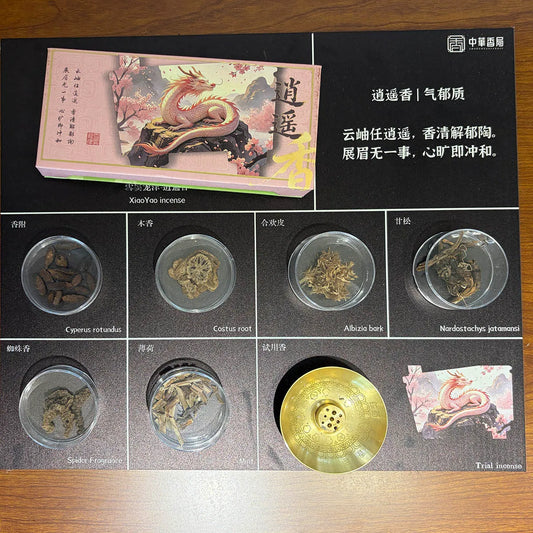
Fu ling is a food, a medicine, and also an incense material. In our Huan Mao incense, fu ling sits alongside cliff cypress, white atractylodes, and licorice, a classical pairing for the digestive system. We follow this framework in four blends, one for each way dampness tends to show up in the tradition's language.
|
If this sounds like you |
Traditional pattern |
Blend |
|
Rich food and long sitting hours, a heavy sluggish feeling after meals |
Spleen deficiency with dampness |
Tai Sui incense |
|
Body heaviness, easy sleepiness, sticky stools, puffiness, joints that complain in wet weather |
Dampness accumulated and thickened |
Bi Fang incense |
|
A constitution quiz said phlegm-dampness, and heavy limbs and slow digestion are your baseline |
Phlegm-dampness constitution |
Qing Lan incense |
|
Everything sticky, with a hot edge: oily skin, irritability in humid weather, stool that is sticky and uncomfortable |
Damp-heat constitution |
Xian Yue incense |
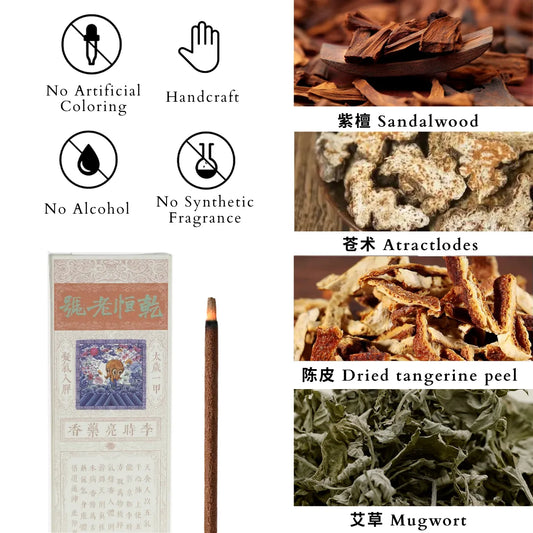
- Tai Sui incense is built on sandalwood and atractylodes (the root the materia medica pairs most directly with drying dampness and strengthening the spleen). It follows the pattern the tradition ties to rich food and sedentary fatigue.
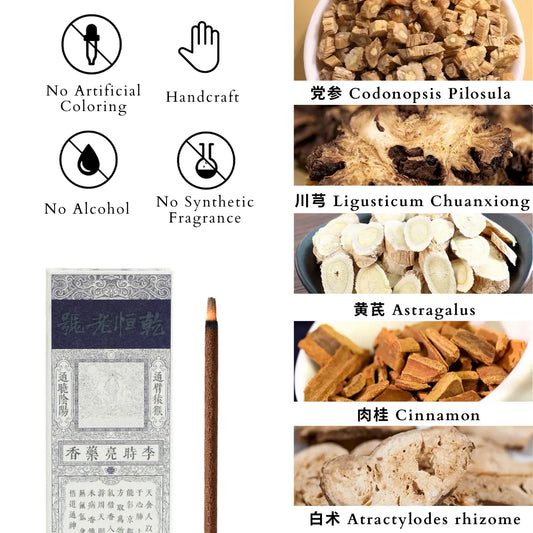
- Bi Fang incense is built on red sandalwood, poria, and clove, under a warming, drying formula like the direct descendant of the sachet logic.
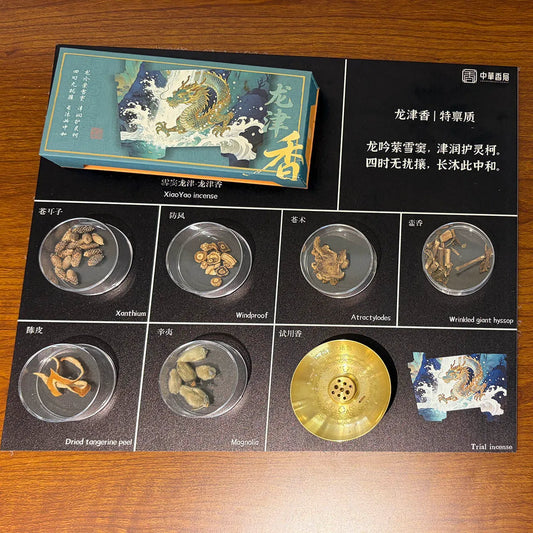
- Qing Lan incense is built on dried tangerine peel and atractylodes, the pairing the materia medica names most often for transforming phlegm-damp.
- Xian Yue incense runs cooler, on mint, agastache, and atractylodes, for dampness that has taken on heat.
The same body of herbal knowledge supplies a pantry and an incense box. One route is eaten, the other is smelled.
Questions people ask
Is dampness the same as water retention? No. The descriptions overlap, and the concepts come from different systems. Dampness is a pattern of symptoms in Chinese medicine. Water retention is a clinical finding in modern medicine. If you have visible swelling, get it checked.
Which beans should I buy? Round and glossy for a pot that cooks to sand. Slender and dark for the traditional draining formula. Both are red beans, and they behave differently in water.
How often should I drink it? Household practice runs two or three times a week. It is a food, so frequency is a matter of habit rather than dosing.
Will this help me lose weight? The tradition connects excess weight to a sluggish digestive system, and it treats the sluggishness.
Is incense part of this tradition? Aromatic herbs were used for dampness in classical practice, and the sachet is the folk version of that idea. We make four scent products on this framework, matched to the traditional patterns described above.
A closing note
The most useful thing in this tradition may be the least exotic. It is the habit of paying attention to heaviness, sluggishness, and a digestion that feels stuck, and treating those as early signals rather than background noise. That habit is worth keeping even if you set the cosmology aside.