Best Incense for Reading: How to Choose a Scent That Won’t Distract You
You finally have an hour to read.
The house is quiet. Your phone is out of reach. You open your book, settle into your chair—and then realize the incense you lit five minutes ago is all you can smell.
It is too sweet. Too smoky. Too strong.
Instead of disappearing into the book, you keep noticing the fragrance.
That is the problem with choosing incense for reading based only on what smells good in the first few minutes.
The best incense for reading is not necessarily the strongest, most relaxing, or most popular fragrance. It is the one that supports the atmosphere without competing for your attention.
This guide explains how to choose incense for reading based on fragrance intensity, aromatic materials, burn format, room size, and the kind of reading you actually do.
We will also look at why scent can become part of a repeatable reading routine—and why it is better to think of incense as a sensory cue, rather than a guaranteed concentration aid.
Does Incense Actually Help With Reading?
Let's start with the question behind the question:
Can incense actually help you concentrate while reading?
There is not enough evidence to claim that a particular incense material, such as sandalwood or agarwood, directly improves reading ability or concentration.
That distinction matters.
You will often see fragrances marketed as “focus scents” or “study incense,” but a product label is not scientific evidence.
What is more interesting is the role that smell can play as a contextual cue.
Research on olfactory context suggests that odors can become associated with a particular environment or activity and, under some conditions, influence memory retrieval. Studies have found effects when the same odor context is present during learning and later recall, although the effects depend on the task and conditions.
For reading, this suggests a more realistic use of incense:
You are not burning incense to force your brain to focus. You are creating a consistent sensory environment that can help distinguish reading time from everything else in your day.
If you use the same subtle scent whenever you sit down to read, the fragrance can become part of that routine.
That is a much more useful way to think about “incense for reading.”
The Real Problem: Your Incense Can Become a Distraction
Imagine two reading sessions.
Session A
You light an incense with a very strong fragrance.
For the first few minutes, it smells wonderful.
Then the fragrance becomes stronger as the room fills with smoke. You notice it every time you turn a page. You wonder whether you should open a window. Eventually, you stop reading to move the incense farther away.
The incense has become part of the task.
Session B
You choose a quieter woody fragrance.
You barely notice it after the first few minutes. The room simply smells different from the rest of your home.
You read for forty minutes without thinking about the incense.
For reading, Session B is usually the better outcome.
This leads to a simple principle: The best reading incense stays in the background.
If you keep thinking:
“Wow, this incense smells strong.”
it may be too prominent for a long reading session.
For reading, you generally want:
- a fragrance you can tolerate for an extended period
- moderate rather than overwhelming intensity
- a relatively stable aromatic character
- enough character to create atmosphere
- but not so much complexity that you continually analyze the scent
In other words:
Don't choose incense that demands attention when your book already has it.
What Makes an Incense Good for Reading?
Instead of asking which incense is “best,” evaluate it using four practical criteria.
1. Fragrance Intensity
Intensity is probably the first thing to consider.
A scent that feels beautiful in a store for five minutes may become tiring after forty-five minutes in a small room.
For reading, start with less fragrance rather than more.
If you have to keep thinking about the scent, reduce the amount, increase the distance, improve airflow, or choose a subtler product.
A useful test
Before committing to a long reading session, burn or experience the incense for a short period.
Ask yourself:
Could I comfortably smell this for the next hour without wanting it to disappear?
If the answer is no, it probably isn't your ideal reading incense.
2. Fragrance Character
Not all strong fragrances are strong in the same way.
A simple woody aroma may feel quieter than a highly sweet, floral, or perfume-like fragrance even when both have noticeable intensity.
For reading, many people prefer aromatic profiles that feel:
- woody
- warm
- dry
- softly resinous
- herbal
- understated
But this is ultimately personal.
Someone who loves floral fragrance may find a subtle floral incense less distracting than sandalwood.
The important point is not to follow a universal “focus scent” list.
Choose the fragrance character that you naturally find easy to live with.
3. How the Fragrance Changes While It Burns
This is where incense differs from many passive fragrance products.
The aroma can change as the material heats and burns.
A fragrance that smells quiet at the beginning may become richer or more pronounced later.
This matters for long reading sessions.
You are not choosing a scent based only on its first impression.
You are choosing an experience that may last twenty, thirty, sixty minutes, or longer depending on the format.
That is why burn development is worth paying attention to.
If a fragrance becomes significantly stronger or more distracting as the session progresses, it may be better suited to short atmospheric use than extended reading.
4. The Format
The right incense for reading is also determined by how you use it.
A traditional incense stick, a coil, a sachet, and a wearable incense piece create very different experiences.
That gives you more options than simply asking:
“Which scent should I buy?”
A better question is:
“How do I want fragrance to exist around my reading?”
The Best Incense Materials for Reading
Different aromatic materials create different experiences. Rather than promising that one material will “improve focus,” consider what kind of fragrance environment each one creates.
Sandalwood: Warm, Smooth, and Understated
Sandalwood is one of the most approachable choices for reading.
Its character is generally associated with a warm, soft, creamy, woody profile rather than a sharp or aggressively perfumed one.
That makes it a natural starting point if you want incense to sit quietly in the background.
Sandalwood can work particularly well for:
- everyday reading
- morning reading
- long reading sessions
- reading in a study or home office
- books that require sustained attention
If you are new to incense and don't know where to start, sandalwood is one of the materials worth exploring first.
Explore Sandalwood Incense →
Agarwood: Deep, Complex, and More Atmospheric
Agarwood is a very different experience.
Its aroma can be deep, resinous, woody, and highly nuanced, with considerable variation depending on the material and formulation.
That complexity can be part of its appeal.
But it also means agarwood may be more noticeable than a very restrained woody incense.
Agarwood can be a good choice when your goal is not simply “background scent,” but a more immersive atmosphere.
Think:
evening reading
long-form fiction
quiet reflection
a slower reading session
The key is moderation.
Explore Agarwood Incense →
Frankincense: Bright and Resinous
Frankincense has a distinctive resinous character that can feel brighter and more expressive than soft woods.
It may work well if you find purely woody fragrances too quiet or want a more defined aromatic presence.
Because the profile is more noticeable for some people, try it in a smaller amount or larger, well-ventilated space before committing to a long session.
Explore Frankincense Incense →
Herbal and Botanical Blends: The Wild Card
“Herbal incense” covers a much broader range of materials than many people realize.
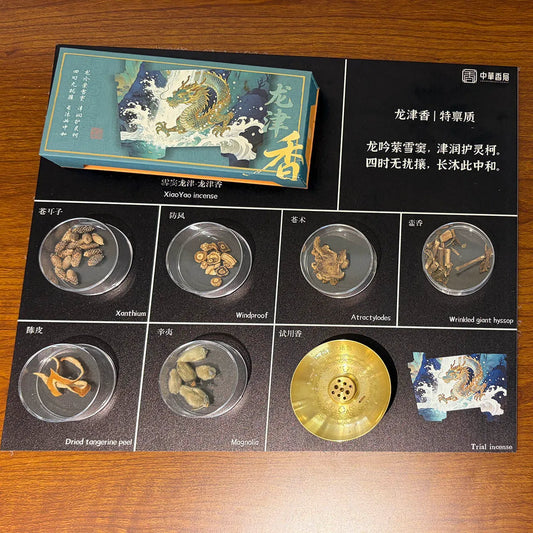
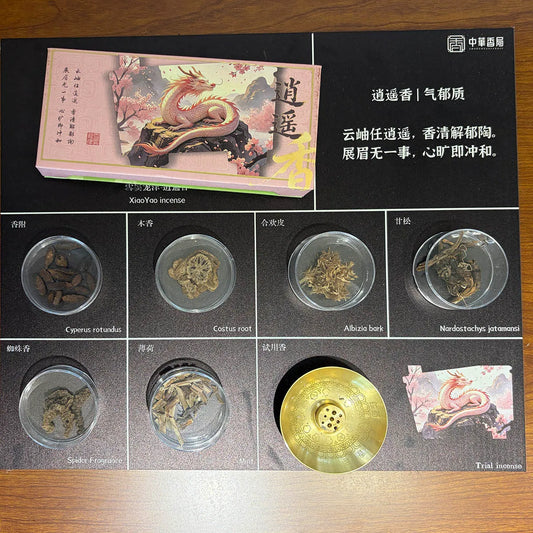
Traditional botanical incense can include combinations of:
- woods
- resins
- roots
- herbs
- flowers
- spices
- other aromatic plant materials
The result can range from soft and woody to earthy, spicy, resinous, floral, or highly complex.
That makes botanical blends interesting for experienced incense users—but also harder to predict from the word “herbal” alone.
If you are buying a blended incense for reading, look beyond the category name and find out what materials are actually in the formula.
Explore Botanical Incense →
Choose Incense Based on Your Reading Situation
Your ideal reading incense may change depending on what you are doing.
And this is where the original article's “mystery = woody, fantasy = resinous” approach should be abandoned.
The book genre is less important than the reading situation.
1. When You Are Reading Before Work
You have twenty minutes before your day starts.
You don't need a dramatic ritual.
A subtle woody or herbal profile may be enough to create a clear transition between:
waking up → reading → starting the day
Sandalwood is a natural place to start.
Keep everything else simple.
2. When You Are Reading for an Hour or More
Long sessions require more attention to fragrance intensity.
Choose something you can comfortably experience for a long period.
This is where a smooth, restrained woody fragrance may have an advantage over a very strong or highly sweet fragrance.
Your goal is not maximum aroma.
It is minimum distraction with enough atmosphere to make the session feel distinct.
3. When You Are Reading Fiction at Night
Evening fiction gives you more freedom to choose an atmospheric fragrance.
A deeper woody or resinous profile may complement the slower pace of an evening reading session.
Agarwood can be particularly interesting here if you enjoy complex, darker aromatic profiles.
But again, the question is:
Do you enjoy the fragrance, or are you constantly noticing it?
If the latter, use less.
4. When You Are Studying or Reading Nonfiction
This is where I would be especially conservative.
If you are reading technical material, studying for an exam, or trying to process dense information, don't create an unnecessarily stimulating sensory environment.
Use a familiar, subtle fragrance—or skip burning incense altogether.
The book should remain the most interesting thing in the room.
5. When You Read in a Small Room
Room size changes everything.
The same incense that feels subtle in a large living room may become overwhelming in a small bedroom or office.
If your reading space is small:
- use less
- increase the distance from where you sit
- maintain appropriate ventilation
- consider a non-burning fragrance format
And don't assume “natural” means that smoke does not matter.
Burning incense produces particulate matter, and studies have measured substantial PM2.5 emissions from different incense products. Research also shows that incense-generated particles can disperse beyond the immediate room.
For a reading nook surrounded by books and paper, less is often the smarter choice.
Traditional Chinese Incense and the Scholar's Reading Space
There is another reason incense and reading make an interesting pairing for Panda Incense.
The association is not something we need to invent for modern marketing.
Incense became part of Chinese literati culture, particularly during the Song period, when fragrance, tea, calligraphy, painting, books, and other forms of cultivated daily life were increasingly connected.
Historical Chinese incense culture was also much broader than simply burning sticks. Aromatic materials could be blended, powdered, shaped, burned in different forms, or carried as personal fragrance.
This is important because the modern idea of an “incense reading ritual” is not simply:
ancient Chinese people read books while burning incense.
That would be an oversimplification.
A better interpretation is that fragrance was one element within a larger sensory culture surrounding study, appreciation, conversation, tea, objects, and quiet attention.
That distinction gives the modern ritual more meaning.
You don't have to recreate a historical scholar's studio.
You can simply borrow one principle:
Make your environment support the activity rather than compete with it.
For more on the history and forms of traditional Chinese incense, read our guide to Traditional Chinese Incense →
Burning Incense vs. Non-Burning Incense for Reading
This is a decision the original article should have addressed much more directly.
Because not every reader actually wants smoke.
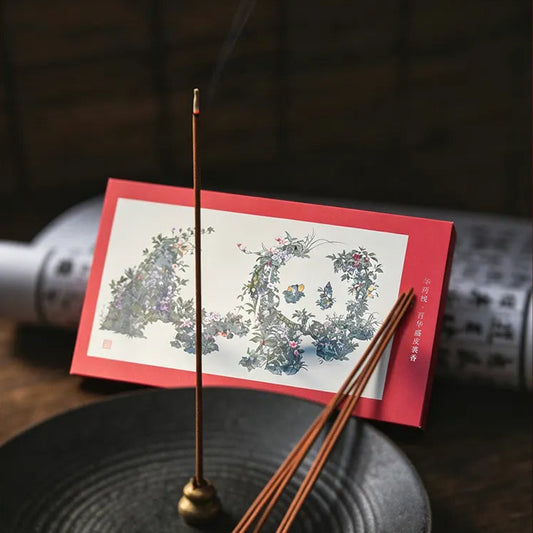
Incense Sticks
Best when you want:
- a traditional incense experience
- a clearly defined beginning and end
- fragrance to become part of the room
They are simple, familiar, and easy to incorporate into a reading routine.
But because they involve combustion, use a stable heat-resistant holder, keep them away from books and other flammable materials, never leave them unattended, and maintain appropriate ventilation.
Incense Coil
Incense coil is useful when you want a longer-burning format.
Its spiral shape allows a relatively long length of incense to occupy a compact space.
For readers who prefer longer sessions, it can become a natural part of an extended reading ritual.
Just remember that longer burn time also means longer exposure to smoke.
Longer does not automatically mean better.
Incense Sachets
A scented sachet gives you another way to incorporate botanical fragrance without burning incense.
This can work particularly well if:
- you share your living space
- you read in different rooms
- you don't want smoke around your books
- you prefer subtle fragrance
- you want something portable
For some readers, this may actually be a better “reading incense” solution than burning incense.
Wearable Incense Jewelry
Wearable incense takes the idea one step further.
A He Xiang bracelet, necklace, or incense accessory allows fragrance to become personal rather than room-filling.
This is particularly useful if you:
- read outside your home
- study in a library
- travel with books
- share a room
- don't want to burn anything
- prefer fragrance close to you rather than throughout the room
It also connects naturally with the long Chinese tradition of carrying fragrance, while contemporary incense jewelry should be understood as a modern interpretation rather than presented as an exact historical replica.
Explore Wearable Incense →
How to Use Incense While Reading Without Letting It Take Over
You don't need a complicated ritual.
In fact, the more complicated it becomes, the less likely you are to repeat it.
Try this:
1. Choose the same reading location
It doesn't need to be a Pinterest-perfect reading nook.
A chair, desk, sofa, or corner of your bedroom is enough.
2. Put your phone away
This is probably more important for concentration than choosing between sandalwood and agarwood.
Don't pretend otherwise.
If your phone is constantly within reach, changing your incense isn't going to solve the problem.
3. Choose one familiar fragrance
Don't switch between five fragrances every night.
Start with one.
Give yourself enough time to understand whether you actually enjoy it over longer sessions.
4. Keep the fragrance subtle
If you're constantly thinking about the incense, adjust it.
Move it farther away.
Use less.
Improve ventilation.
Or choose another format.
5. Start reading
This is the part people sometimes forget.
The purpose of the ritual is to get you into the activity faster.
It is not another productivity project.
A Simple Reading-Incense Decision Guide
Not sure where to start?
Use the question that actually describes your situation.
“I want something quiet and easy to live with.”
Try: Sandalwood or a restrained woody blend.
“I want something deeper and more atmospheric.”
Try: Agarwood or a resinous blend.
“I want a more distinctive resinous character.”
Try: Frankincense.
“I want to explore traditional botanical formulations.”
Try: A botanical or He Xiang blend.
“I don't want smoke around my books.”
Try: Incense sachet or wearable incense.
“I read in different places.”
Try: Wearable incense or a portable non-burning format.
“I study and don't want fragrance to distract me.”
Try: The most subtle familiar scent—or none at all.
That last option is important.
You don't need incense to make reading meaningful.
If fragrance distracts you, remove it.
A good incense brand should be comfortable telling you that.
How to Find Your Personal Reading Incense
Instead of searching endlessly for “the best incense for reading,” run a simple experiment.
Choose one fragrance.
Use it during three or four reading sessions.
Keep the conditions reasonably similar.
Then ask:
- Did I enjoy the fragrance after 30 minutes?
- Did I notice the incense repeatedly?
- Did the fragrance become stronger or more distracting over time?
- Did I enjoy reading more because the environment felt distinct?
- Would I willingly use the same fragrance again?
That last question is probably the most useful.
You are not testing whether sandalwood magically improves your brain.
You are testing whether this particular fragrance helps you create a reading environment you actually want to return to.
And that is a much more sustainable reason to use incense.
Build a Reading Ritual Around the Book, Not the Incense
A good reading ritual should eventually disappear into the background.
You sit down.
You know where your book is.
Your phone is somewhere else.
The light is comfortable.
The fragrance is familiar.
And then you start reading.
You don't think:
“What a beautiful reading ritual I'm performing.”
You simply read.
That's the point.
The incense is not the experience. It helps create the conditions for the experience.
Why Panda Incense Takes a Material-First Approach
At Panda Incense, we don't think there should be one “focus incense” that everyone uses.
Different aromatic materials create different experiences.
Sandalwood can offer a softer, warmer woody character. Agarwood can bring greater depth and complexity. Frankincense introduces a distinct resinous profile. Botanical and He Xiang blends allow multiple aromatic materials to interact.
And different forms create different ways of experiencing fragrance.
You can burn a stick.
You can use a coil for a longer session.
You can carry a scented sachet.
Or you can wear a contemporary incense piece when burning incense isn't practical.
The choice depends on how you read, where you read, and how much fragrance you actually want around you.
That's why our approach starts with the material and the experience—not with a claim that one scent will make you more productive.
Explore Panda Incense for Your Reading Ritual →
Frequently Asked Questions
What is the best incense for reading?
There is no universally best incense for reading. A good choice is a fragrance you enjoy for an extended period without finding it distracting. Sandalwood is a useful starting point if you prefer a warm, understated woody profile.
Does incense help with concentration while reading?
There is not enough evidence to claim that a particular incense directly improves concentration. Research on olfactory context suggests that scent can sometimes act as a contextual cue for memory, but this should not be confused with a guaranteed focus-enhancing effect.
Is sandalwood good for reading?
Sandalwood can be a good choice for reading if you enjoy warm, smooth woody aromas. Its relatively understated character makes it worth considering for longer reading sessions, although fragrance preference is highly personal.
Is agarwood good for reading?
Agarwood can work well for readers who enjoy deeper, resinous, complex aromas. Because it can have a more pronounced character than softer woods, start with a level of fragrance that remains comfortable during a longer reading session.
What is the best incense for studying?
For studying, choose a familiar fragrance that remains subtle rather than selecting a product simply because it is marketed as a “focus incense.” If fragrance becomes something you actively notice, it may be too strong for the task.
Can you burn incense while reading?
Yes, but use appropriate precautions. Keep burning incense in a stable holder away from books, paper, curtains, and other combustible materials. Never leave burning incense unattended and maintain appropriate ventilation. Burning incense produces particulate matter, so a well-ventilated environment is preferable to a small enclosed room.
What incense is best for a small reading room?
A subtle fragrance or non-burning format may be more appropriate for a small reading room. You can also reduce the amount used, increase the distance between the incense and your reading position, and maintain appropriate ventilation.
Can I use incense without burning it?
Yes. Incense sachets and purpose-designed wearable incense formats provide non-burning ways to incorporate fragrance into a reading routine. Always use each product according to its intended design.
Is incense safe around books?
Burning incense should never be placed directly beside books or loose paper because the ember and ash create a fire risk. Smoke and residue can also accumulate on nearby surfaces. Keep burning incense at a safe distance and use a suitable holder.