Why Incense Beads Change Color: Patina and Skin Chemistry
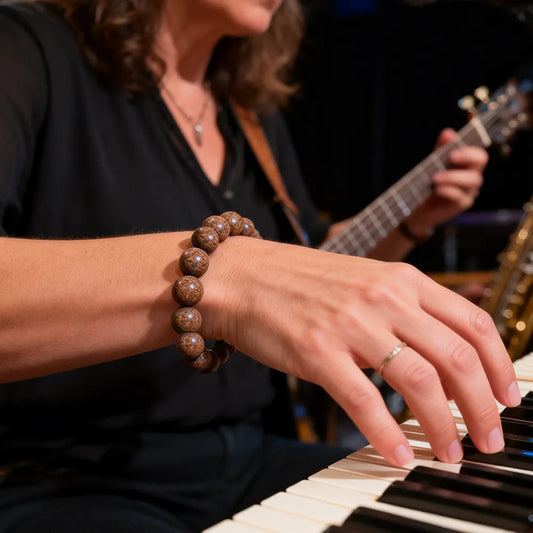
The one-minute version. Yes, your beads are supposed to do that. Incense beads are made of aromatic powders pressed together without metal, lacquer, or plastic, so their surface is quietly porous, and three forces act on it from the day you first wear it: the oils and moisture of your skin, the friction of handling, and the oxygen in the air. The result is a slow change in color and luster that Chinese collectors have prized for centuries under the name bao jiang (包浆), the patina that time and hands give to a cherished object. The change genuinely does differ from person to person, and skin chemistry explains a lot of it. Also, the old tradition read those differences as clues about the wearer's body, and we will tell you about that reading too, as culture and history.
Now the full story, which starts with a customer email we did not expect.
The email that started this article
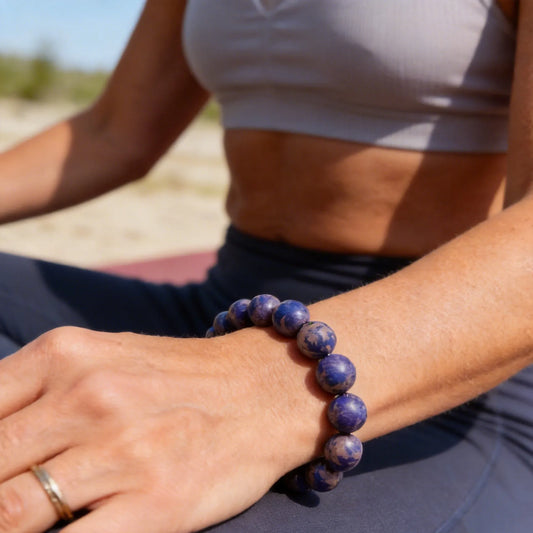
A few months after we started shipping our bead bracelets, a customer wrote to us, half delighted and half worried. Her bracelet had deepened in color since it arrived. The beads were darker, warmer, and glossier near her wrist, and she wanted to know whether something was wrong. Around the same time, another customer asked almost the opposite question: why her beads were getting brighter and more polished while a friend's, from the same batch, were going deeper and darker.
Nothing was wrong with either bracelet. Both were doing what pressed herbal beads have always done: changing slowly with the person who wears them. But the two questions deserve a real answer, and the answer runs through chemistry, craft, and a very old Chinese idea about objects that spend their lives with a person.
Why these beads change at all: the material, plainly
Start with what an incense bead is. Our beads are made the classical way: aromatic woods, resins, and herbs ground fine, blended, bound, and pressed into shape, then dried slowly. No metal, no lacquer coat, no plastic sealant. The surface that touches your skin is the material itself.
Compare that with the objects Americans are used to wearing. Gold, silver, and steel are dense and closed; skin oils sit on top of them and wipe away. A pressed herbal bead is closer to unfinished wood or a clay flowerpot. It is full of microscopic channels, and it drinks. Every hour on your wrist, it absorbs a small amount of sebum (the natural oil your skin produces), a small amount of moisture, and a small amount of warmth. This is the same reason wood-handled kitchen knives feel smoother after years of use, and the same reason a leather wallet goes from stiff to supple: porous materials keep a record of what touches them.
Three processes are running at once:
Absorption. Oils and moisture sink into those channels, filling them. Filled channels reflect light differently than empty ones, so the bead looks deeper, richer, darker. This is most of what people call darkening.
Oxidation. Skin oils are not inert. Their components react slowly with oxygen and take on deeper tones. This is the same basic chemistry that turns linseed oil into varnish on an artist's canvas, and that turns the oil layer on a cast-iron skillet into the hard black seasoning cooks aim for. Time plus air plus oil equals transformation; the bead is just a small canvas.
Friction. Every pass of your thumb, every rub against a sleeve, micro-polishes the surface. Woodworkers call this burnishing: pressing and rubbing a surface until it shines without any varnish at all. It is why the beads that get handled most, rather than the ones that sit in a drawer, develop the deepest glow.
None of this is damage. Nothing is coming off the bead; things are going in, settling down, and being smoothed. If you want a one-line summary: metal jewelry ages by wearing out, herbal beads age by filling in.
Why yours and hers age differently: your skin is a chemical environment
Here is where the two customers from the opening come back in, because the difference between their bracelets was never about the bracelets.
Your skin runs an active chemistry. Its surface sits under a thin acidic film that dermatologists call the acid mantle. In a multi-center study of 330 volunteers, natural skin surface pH averaged about 4.7, well below neutral (Lambers et al., 2006, International Journal of Cosmetic Science). That number is not fixed. It shifts with washing, water, products, and person. The same study found that plain tap water alone nudges skin pH upward for up to six hours afterward, and ordinary soap (typically pH 9 to 10) shifts it further.
For a porous bead, the practical meaning is this: your wrist is not just touching the beads, it is marinating them, and every wrist's marinade is a little different.
People whose skin and hands run moister, or who live in humid climates, feed the beads more water. Water fills the pores, deepens the tone, and speeds up the dark, saturated look. People whose skin runs drier contribute less moisture and more friction polish, so their beads tend toward brightness and sheen first, deepening later. Office workers who wash and sanitize their hands ten times a day are running a different experiment than a gardener. None of these outcomes is better; they are just different recipes of oil, water, air, and friction.
That is the honest, measurable layer of the story. Now for the older layer, the one measurement can't reach.
Bao jiang: the Chinese idea that time leaves a signature
In Chinese, the sheen that develops on a long-handled object has a name: bao jiang (包浆). Collectors of wenwan (文玩), the culture of cultivated desk and hand objects, use the word for the glow on walnut shells, bamboo handles, jade, ink cakes, and beads: a luster that no workshop can fake because its only ingredient is accumulated time with a person.
People may be confused if they did not grow up around it. In much of the modern world, an object's peak condition is its factory condition, and wear is decline, for example, the phone with the scratched screen, the shoes with the creased toe. The bao jiang view inverts this. A cherished object's most beautiful state is its final one, decades out, when the surface carries the record of every hand that held it. In this view, wear is the object filling in, slowly, rather than wearing out. If you have ever seen an American leather goods brand advertise "the patina tells your story," you have met this idea in translation. Chinese collectors just never sent it away.
And they read patina, traditionally, in both directions. Not only what your hands are doing to the beads, but what the beads suggest about your hands. This brings us to the part of our customers' question that needs both respect and care.
The tradition's reading: dampness, dryness, and what a bead can tell you
In Traditional Chinese Medicine's way of seeing, the body has seasons and weathers of its own. A core concept is shi (湿), dampness: a state of internal humidity that the tradition associates with heavy weather in the body, sluggish digestion, and climates or habits that keep things wet. Its counterpart is dryness. In the traditional frame, a TCM practitioner would look at the moist-handed customer's darkening beads and say something like: your body carries dampness, and your beads agree. To the dry-handed one: your beads brighten because you are dry, and dry skin polishes.

The tradition goes a step further, and this is the part with real intellectual depth. Its founding text, the Huangdi Neijing (Yellow Emperor's Inner Classic), is more than two thousand years old. Its founding ambition appears in the Suwen: "the sage governs those who are not yet ill, rather than those who have already fallen ill." In Chinese: 治未病, governing disease before it exists. The bracelet, in this frame, is not a remedy. It is a readable surface: a small, daily, physical reminder to notice yourself, the way a gardener reads leaves before the plant is visibly sick.
Here is the part where we owe you the same honesty we owe the FDA. Is there scientific evidence that a bead's color diagnoses your internal dampness, or anything else about your health? No. No study supports reading health from a bead, and a bracelet is not a diagnostic tool. Anyone who tells you their beads can test your body is selling you something. What the color change genuinely reflects is measurable and real: how much you wear it, what your skin type is, how humid your climate and habits are, how often you wash your hands, whether you took it to the beach. If your beads suddenly darken faster, the most likely explanations are a heat wave, a new hobby, or a new hand cream, in roughly that order.
But notice that the tradition's reading and the honest reading converge on the same practical move. Whether you call it tending dampness or checking your habits, the advice is: pay attention early, adjust small things early, and don't wait for the loud symptom. That philosophy, prevention over reaction, is a good idea no matter which tradition hands it to you. Carried into a modern American life, 治未病 becomes simple: check in with yourself early, and see a doctor when something persists. A bead can be the reminder. Your own judgment, and your doctor, do the diagnosing.
How to develop a good patina (and a few ways to ruin one)
If you want the deep, even glow the collectors are after, the recipe is boring and reliable:
- Clean, dry hands. Oils from your own skin are the finish. Kitchen grease, lotion, and sunscreen will darken beads into a muddy, uneven tone that reads as dirt, because it is.
- Short and often beats long and rarely. Twenty minutes of handling a day develops a more even surface than once-a-month marathons.
- Keep it off the water. Showering, dishwashing, and swimming swell the pores and can leave tide lines. Even the pH of tap water is enough to matter for your skin (see the study above), so imagine what an overnight soak does to a bead.
- Mind the perfume. Spray fragrance on skin or clothing first, let it dry, then put the bracelet on. Alcohol and essential-oil concentrates spot-treat whatever they hit.
- Store it sealed when not worn. A small tin or pouch keeps dust off and, as a bonus, lets the bead's own scent concentrate and recharge.
- Wipe, don't wash. A dry soft cloth after a day's wear is the entire maintenance program.
Expect the visible change over weeks to months of daily wear, faster in humid summers, slower in dry winters. Uneven darkening near the cuff or clasp is normal; those beads simply work different shifts. And if one bead darkens faster than the rest, that is the one under your thumb most often. The bracelet is keeping time, and it is keeping yours.
FAQ
Is the color change mold?
Almost certainly not. Mold needs persistent moisture, and it announces itself: a musty smell, a fuzzy surface, soft spots. A developing patina is dry, hard, and scent-neutral (the fragrance may soften but should stay clean). If your beads ever smell musty, that is a storage problem; dry them thoroughly in open air and change how you store them.
Is this the same thing people talk about with mala beads?
Same family of processes, different material. Bodhi seeds and rudraksha darken as their pores take in oils and air, which is why the question "why do mala beads darken" has a whole corner of the internet. Pressed incense beads add a wrinkle the seed beads don't have: they are blended and compressed from many aromatic materials in the first place, so their surface is even more receptive, and the scent evolves along with the color.
Will it darken forever?
The change is front-loaded. Deepening is fastest in the first months and slows as the pores fill, settling toward a warm, stable tone. Collectors describe the curve as quick youth, long adulthood, and then very slow deepening for the rest of the object's life.
Can I speed it up with oil?
We advise against it. Foreign oils sit on the surface and trap dust instead of curing into it, and they can go rancid and dull. Your own skin, in modest daily doses, is the right oil, in the right amount, delivered by the right machine: your hand.
Did the imperial court's beads do this too?
They did, and theirs are the ancestors of ours. The Qing court's heat-relief fragrance beads, hung from the lapel every summer, were pressed from blended herbs in the same basic way, and the surviving examples in the Palace Museum carry centuries of exactly this transformation. We traced that full story in our article on ding zi yao, the wearable medicine of the imperial court.
Start your own patina: wearable Incense bead bracelets, hand-pressed by Panda Incense, each one blank where your days go.