Nine Body Constitutions, Nine Formulas: The Design Logic Behind Xuedou Dragon Stream
Share
Anyone who burns incense regularly notices something odd. The same stick that felt perfect last night can fall flat this morning. The scent did not change. Your state did. Some evenings you want to slow down after a long shift. Some mornings you need a clear head before the first meeting. Traditional Chinese Medicine (TCM) observed this kind of variation in people a long time ago, and it gave the observation a name: body constitution, known in Chinese as tizhi (体质).
The most widely used modern version of this idea comes from Wang Qi and his research team at Beijing University of Chinese Medicine. In 2009, the China Association of Chinese Medicine turned their work into a national standard, Classification and Determination of Constitutions in TCM (《中医体质分类与判定》). It describes nine patterns a body tends toward: one balanced baseline, plus eight patterns that traditional practitioners associated with qualities such as cold, dampness, dryness, and sensitivity.
One honest note before the list. A stick of incense does not change your constitution immediately. Most people are a mix of two or three patterns anyway. The self-test included in the standard exists precisely because few people fit one box.
For us, the framework worked in one specific direction. Each of the nine Xuedou Dragon Stream herbal incense formulas was composed with a single constitution in mind. The framework decided which materials went into the box and in what ratio. What you read on our product pages stays focused on scent and occasion. The constitutions are the design logic, and this page is where we show it.
Here is the full map, then the detail.
|
Constitution |
Classical picture |
Incense stick |
|
Balanced 平和质 |
Steady sleep, even appetite, quick-recovering temper |
Chang Su incense 长苏香 |
|
Qi stagnation 气郁质 |
Runs stressed; feel depressed; hard to switch off in the evening |
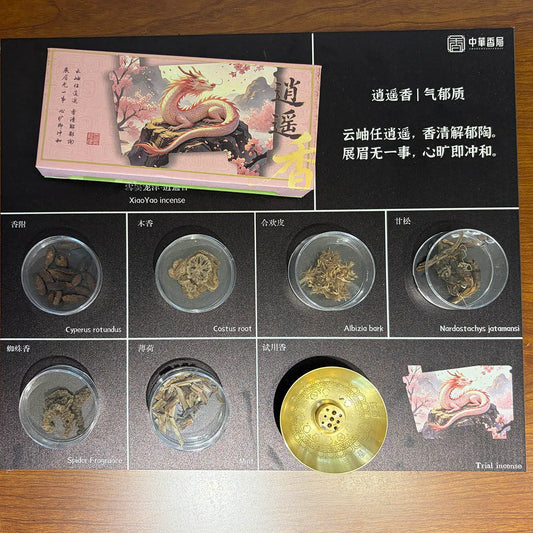
Xiao Yao incense 逍遥香 |
|
Yang deficiency 阳虚质 |
Cold hands and feet; prefers warm rooms and drinks |
Xu Yang incense 煦阳香 |
|
Yin deficiency 阴虚质 |
Heat in the palms toward evening; wound-up at night |
Gan Lu incense 甘露香 |
|
Qi deficiency 气虚质 |
Battery runs out by mid-afternoon |
Fu Yao incense 扶摇香 |
|
Phlegm-dampness 痰湿质 |
Heavy limbs; groggy in humid weather |
Qing Lan incense 轻岚香 |
|
Damp-heat 湿热质 |
Oily skin, bitter morning taste; hates muggy summers |
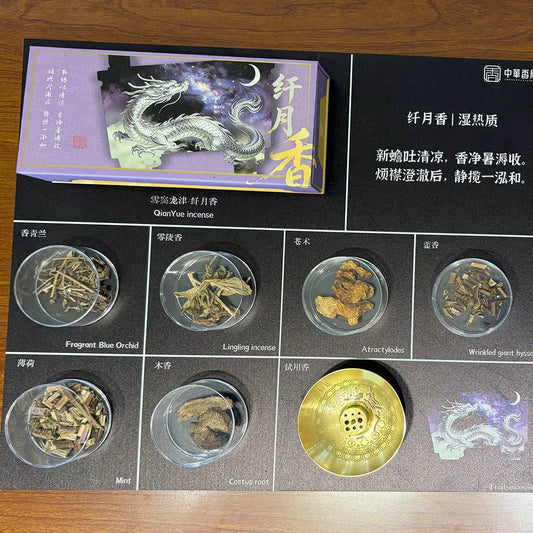
Xian Yue incense 纤月香 |
|
Blood stasis 血瘀质 |
Classical markers: dark complexion, easy bruising |
Tong Qu incense 通衢香 |
|
Special/敏感 特禀质 |
Allergy-prone; reacts to pollen, dust, strong scents |
Long Jin incense 龙津香 |
1. Balanced Constitution
The framework starts from a baseline the other eight bend away from. A balanced constitution, in the classical description, is unremarkable in the best way: sleep that arrives on its own, an appetite that behaves, a temper that recovers by the next morning. The classical advice for such a person is to keep the routine boring and steady — which is a harder instruction in 2026 than it was in the Ming dynasty.
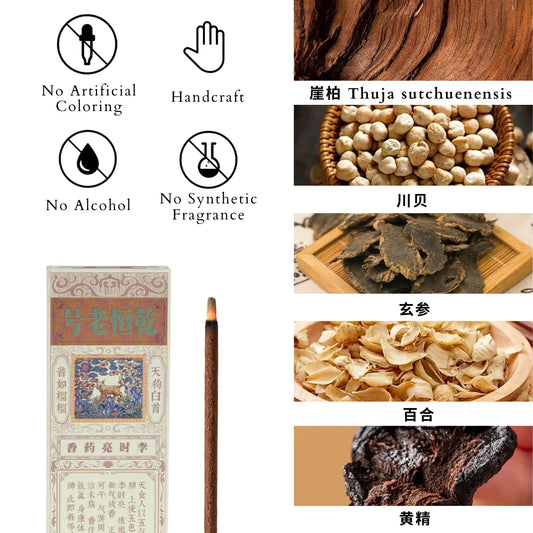
Chang Su incense is the stick built for exactly that: an everyday blend you do not have to think about. Benzoin sets a soft warm base, agarwood sits underneath it, huanghuali and patchouli fill the middle, licorice rounds the edges. Morning tea, reading, or the hour after the dishes are done.
2. Qi Stagnation Constitution
If balance is the baseline, stagnation is what happens under pressure. The classical texts describe constrained qi in physical terms — a knotting feeling in the chest, frequent sighing, frustration that has nowhere to go. The modern version of the pattern is recognizable at a glance: someone who runs all day and cannot find the off-switch at night.
Xiao Yao incense is the lightest blend in the line, built for the transition between the two halves of that day. Cyperus and costus root make the airy frame, nardostachys and mimosa bark warm it just enough, field mint and valeriana jatamansi leave a cool finish. Laptop closed, window cracked, twenty minutes before dinner.
3. Yang Deficiency Constitution
The cold pattern. Classically: cold hands and feet that do not fully warm up, a preference for hot drinks and warm rooms, energy that dips whenever the weather does. The classical image is someone who keeps their coat on indoors — which, in an American office set to 68°F, is half the population between November and March.
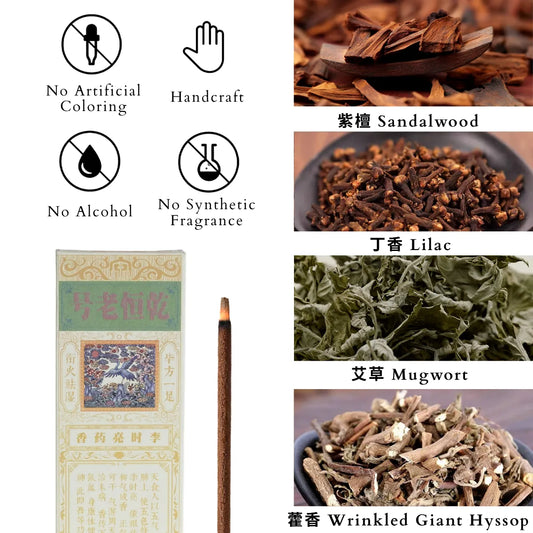
Xu Yang incense is the warmest stick we make, and it is not subtle about it. Cinnamon bark and clove up front, mugwort and dried ginger behind them, benzoin holding the long finish. First cold morning of the year, or any evening your feet disagree with the thermostat — which makes it the collection's natural holiday-season stick, from Thanksgiving, Christmas through the deep of January.
4. Yin Deficiency Constitution
The dry-heat pattern, and the one the classical texts describe most vividly: heat in the palms and soles toward evening (the "five-center heat"), a body that runs warm when it should be winding down, sleep that stays just out of reach. The classical picture is someone whose pilot light burns too high at night.
Gan Lu incense is built the opposite way from Xu Yang — cool and quiet rather than warm. Osmanthus and nardostachys carry it, with a small amount of real fossilized amber giving the smoke a resinous stillness you notice more than you smell. Screens off, book open, last hour of the day.
5. Qi Deficiency Constitution
The low-battery pattern. Classically: tiring on stairs, shortness of breath on exertion, a voice that runs out, an afternoon that has to be pushed through. The classical advice centers on rest and steady rhythm rather than intensity — which happens to be a reasonable description of what a long-workday body wants anyway.
Fu Yao Incense is the grounded, steady stick of the nine: cymbopogon and dried tangerine peel over atractylodes and angelica dahurica, with patchouli in the base. It smells faintly of hay and dried peel. For the end of a day that started too early.
6. Phlegm-Dampness Constitution
The heavy pattern. Classically: limbs that feel weighted, grogginess that lifts when the weather dries out, a constitution associated with humid climates and rich food. Anyone who has spent a July week in the American South knows the sensation the category is pointing at, constitution or not.
Qing Lan incense is the driest, most astringent blend in the line — atractylodes lancea, sichuan pepper, and kaempferia over cyperus and tangerine peel. Built for muggy afternoons when the room itself feels damp.
7. Damp-Heat Constitution
Dampness with heat on top of it. The classical markers are specific: oily skin, a bitter taste in the mouth on waking, a particular hatred of muggy summer days. It is the constitution most associated with high summer in the texts — which makes it the one with the clearest seasonal use.
Xian Yue incense is the summer-evening stick: dragonhead and field mint over patchouli and atractylodes, light enough that it never feels like adding more to a warm room. Porch, dusk, June through August.
8. Blood Stasis Constitution
The pattern classical texts describe in the most physical terms of the nine: a dark or dull complexion, easy bruising, pains that fix in one place rather than moving. The modern reading of the category centers on circulation and movement — it is the constitution most often paired in the literature with exercise and stretching rather than rest.
Tong Qu incense is the resin-heavy stick that matches it: frankincense and myrrh carry the base, cassia and angelica sinensis warm the top, ligusticum threads through the middle. Slow evenings, a long stretching session, a walk that ends at the door rather than the desk.
9. Special Constitution
The sensitive pattern: allergy-prone, reactive to pollen, dust, and strong synthetic fragrance. The classical category exists partly as a caution label: a reminder that some bodies react to things others do not.
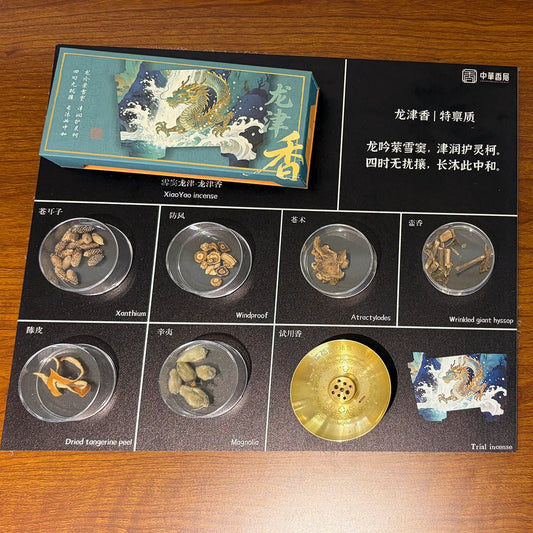
A note of transparency: in classical materia medica, xanthium (苍耳子) and magnolia flower (辛夷) appear together in well-known formulas addressing the nose and breath. That is herbal-medicine history. If you are scent-sensitive, the honest advice is to try any new incense, ours included, one stick at a time in a ventilated room.
Long Jin incense is the most herbal-smelling of the nine: xanthium, magnolia flower, and saposhnikovia with tangerine peel and patchouli, cool with a camphoraceous edge like the inside of an old herb cabinet.
If you do not buy the constitution thing
Fair enough; you do not need it. The same nine sticks, sorted by time of day instead:
|
Your moment |
What you want |
Sticks |
|
Morning |
Something even that does not demand attention |
Chang Su, Long Jin |
|
Focus block |
A scent that marks the start of the work session |
Fu Yao, Chang Su |
|
After-work transition |
Light and airy, the off-switch |
Xiao Yao, Xian Yue |
|
Last hour of the day |
Cool, quiet, low |
Gan Lu, Xu Yang |
|
Stretching, walking, slow evenings |
Deep resin with a long finish |
Tong Qu |
A fuller account of what is in every stick — ingredients, classical sources, the four material families — is on our guide to Chinese incense materials. The nine sticks themselves are here.
How the nine were built
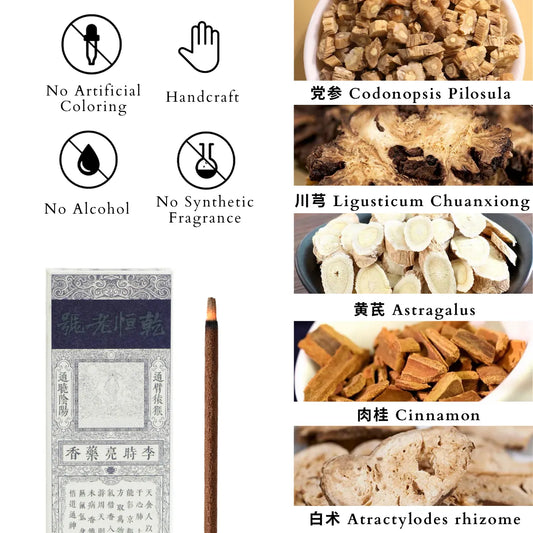
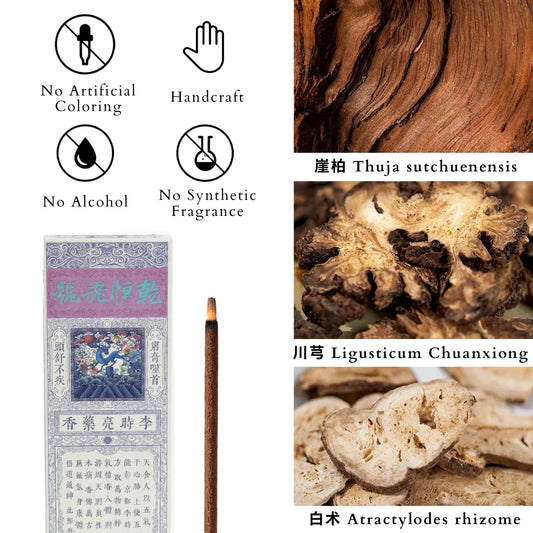
Each formula went through the same workshop process our family has used for five generations: ingredients selected by hand, pao zhi (炮制) preparation, stone-mill grinding, fine sieving, composition under the classical jun-chen-zuo-shi (君臣佐使) structure (chief, deputy, assistant, and envoy, every ingredient carrying a defined role), and slow kneading by hand. Sticks then dry in shade for 7 to 15 days. Selected formulas age sealed in clay jars for a full twelve months before release. The step-by-step is on our production process page.
Frequently Asked Questions
1. What are the nine Chinese body constitutions?
A framework from Traditional Chinese Medicine, written into a 2009 national standard by the China Association of Chinese Medicine based on Wang Qi's research. The nine: Balanced (平和质), Qi Stagnation (气郁质), Yang Deficiency (阳虚质), Yin Deficiency (阴虚质), Qi Deficiency (气虚质), Phlegm-Dampness (痰湿质), Damp-Heat (湿热质), Blood Stasis (血瘀质), and Special (特禀质). It is a traditional framework for describing tendencies, not a diagnosis.
2. How do I know which incense is right for me?
Skip the quiz and start with the moment. Evening unwinding points to Xiao Yao or Gan Lu incense; a focus block points to Fu Yao or Chang Su incense; deep winter points to Xu Yang incense. The time-of-day table above covers the rest, and every stick's full ingredient list is on its product page.
3. Is herbal incense the same as scented incense?
No. Most mass-market incense gets its scent from added fragrance oils and synthetic perfume. Traditional Chinese herbal incense, ours included, gets its scent from the botanical materials themselves: roots, woods, resins, and flowers, ground and blended. The difference shows up on the label and in the burn.
4. How can I use incense in daily life?
Tea, reading, meditation, yoga, the transition after work, the last hour before bed. One rule matters more than any ritual: burn it in a ventilated room, and if you are scent-sensitive, try any new incense one stick at a time.
Where to go from here
Every formula above was developed and blended by Li Shiliang, fifth-generation inheritor of the incense-making tradition 传统香制作技艺 (药香制作技艺), project Ⅷ-224 on China's national intangible cultural heritage list. The constitution framework is cited from the 2009 standard of the China Association of Chinese Medicine; traditional descriptions on this page are historical references, not medical claims. Our incense is sold for its scent and its craft story.