Traditional Chinese Incense: History, Materials, Rituals, and Modern Use
When people hear “Chinese incense,” they may picture a bundle of incense sticks burning in a temple. But traditional Chinese incense is much broader than that.
For centuries, Chinese incense culture has included aromatic woods, resins, roots, herbs, flowers, spices, blended formulas, incense powders, sticks, coils, sachets, and other forms of personal fragrance. Incense has appeared in religious and ceremonial settings, domestic life, scholarly spaces, tea gatherings, and personal adornment.
This diversity is part of what makes Chinese incense distinctive.
Rather than being a single fragrance or product category, traditional Chinese incense is a way of working with aromatic materials. Different materials can be appreciated individually, combined into formulas, shaped into different forms, burned in different ways, or carried as personal fragrance.
Today, these traditions can still be experienced in a modern home—but understanding where they came from makes the experience much richer.
What Is Traditional Chinese Incense?
Traditional Chinese incense, or xiang (香), refers broadly to aromatic materials and incense practices that developed within Chinese cultural history.
The word xiang itself has a broader meaning than the English word “incense.” It can refer to fragrance, aroma, or aromatic materials, as well as incense in the more specific sense.
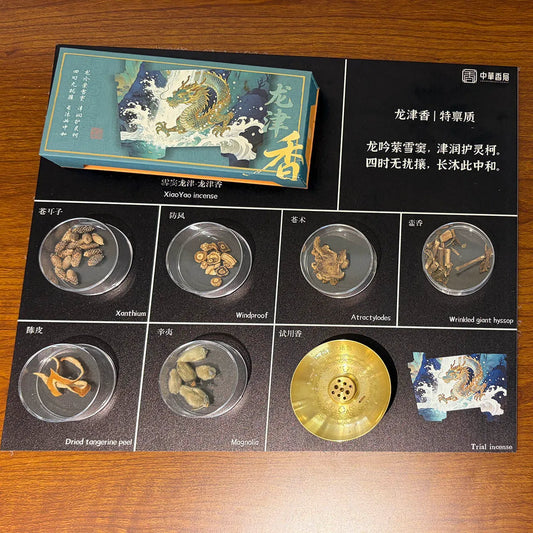
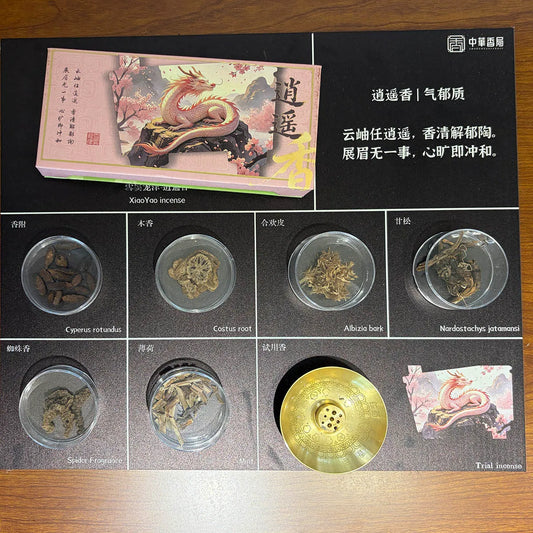
Traditional incense materials could include aromatic woods such as sandalwood and agarwood, resins such as frankincense and benzoin, roots and herbs, flowers, spices, and other botanical materials.
Many of these materials also overlap with the traditional Chinese materia medica tradition. This is one reason Chinese incense is sometimes described in English as “herbal incense.”
However, the terms should not be treated as interchangeable.
Chinese herbal incense can refer to incense made from a broad range of botanical aromatic materials, including woods, resins, roots, herbs, flowers, and spices. Traditional Chinese incense is the broader cultural category that includes these materials as well as the many ways they were formulated, used, and appreciated.
Some aromatic materials had medicinal or materia-medica associations in historical China, but that does not mean an incense product should automatically be considered a medicine or used for therapeutic purposes.
A Brief History of Chinese Incense
The history of Chinese incense is not a simple story of one continuous tradition. Materials, trade routes, technologies, cultural practices, and preferences changed considerably across different periods.
Early Aromatic Materials and Ritual Use
Aromatic plants and materials were used in early Chinese ritual and daily life long before incense became the refined cultural practice associated with later periods.
Fragrance could be connected with ritual, purification, personal adornment, and the use of aromatic plants.
Over time, the range of materials available in China expanded through cultivation, regional trade, and long-distance exchange.
Han Dynasty: New Aromatic Materials Enter China
During the Han dynasty, expanding trade and contact with regions to the west brought new aromatic materials into China.
Agarwood, frankincense, benzoin, and other imported aromatics became part of a much wider fragrance vocabulary.
This exchange was important because Chinese incense culture was never based exclusively on native plants. Imported materials became part of Chinese systems of classification, appreciation, and formulation.
The result was not simply the adoption of foreign fragrances. Over time, these materials were incorporated into Chinese approaches to incense and blended with local aromatic traditions.
Tang Dynasty: Incense in Court and Everyday Life
By the Tang dynasty, incense had become deeply integrated into both religious and secular life.
Incense was used in temples and rituals, but also in elite households and personal life. Historical evidence shows a variety of incense-burning objects and aromatic forms, including incense powders, pellets, cakes, and portable incense vessels.
One particularly fascinating example is the xiangnang (香囊), commonly translated as a scented sachet. Historical evidence shows that the term could refer not only to textile sachets but also to sophisticated spherical metal incense vessels designed to hold burning aromatics while remaining level as they moved.
This illustrates an important point: traditional Chinese incense was not limited to one type of stick. People developed different forms and objects according to how fragrance was meant to be experienced.
Song Dynasty: Incense Becomes a Refined Cultural Practice
The Song dynasty is especially important for understanding the development of Chinese incense culture.
During this period, incense became increasingly accessible and systematically documented. Song scholars produced xiangpu (香譜), or incense catalogues, which recorded aromatic materials and complex incense formulations while helping establish a more systematic knowledge of fragrance. Recent scholarship describes the Song period as a major turning point in how incense was classified, understood, traded, and appreciated.
Incense also became closely associated with literati culture and the appreciation of everyday objects, including tea, calligraphy, painting, and other refined activities.
This is one of the most important differences between simply “burning incense” and participating in a developed incense culture.
The material itself became something to study, compare, combine, and appreciate.
What Makes Chinese Incense Distinctive?
Traditional Chinese incense is distinctive not because it uses one particular ingredient or one particular shape, but because of the relationship between materials, formulation, craftsmanship, and use.
Aromatic Materials Matter
A traditional incense formula may draw from very different categories of aromatic materials.
These can include:
- Aromatic woods such as sandalwood and agarwood
- Resins such as frankincense and benzoin
- Roots and rhizomes
- Herbs and leaves
- Flowers
- Seeds and fruits
- Spices and other aromatic botanicals
Different materials contribute different characteristics. Some provide a deep woody body, others add sweetness, spice, freshness, resinous depth, or subtle herbal notes.
This is why experienced incense users often become interested in individual materials rather than thinking only in terms of finished fragrance names.
What Is He Xiang (合香)?
One of the most important concepts in Chinese incense culture is He Xiang (合香), which literally refers to combined or blended incense.
Rather than relying on a single aromatic material, He Xiang brings multiple ingredients together to create a composed fragrance.
The proportions, materials, and preparation methods can change the character of the finished incense.
Because Panda Incense has a dedicated guide to He Xiang, this article will not repeat its history and formulation details here.
For a deeper look at the history and craftsmanship of He Xiang, read our guide: What Is He Xiang (合香)?
Traditional Chinese Incense Forms
One of the easiest ways to understand the breadth of Chinese incense culture is to look at its different forms.
Incense was shaped according to how it was intended to be burned, displayed, carried, or experienced.
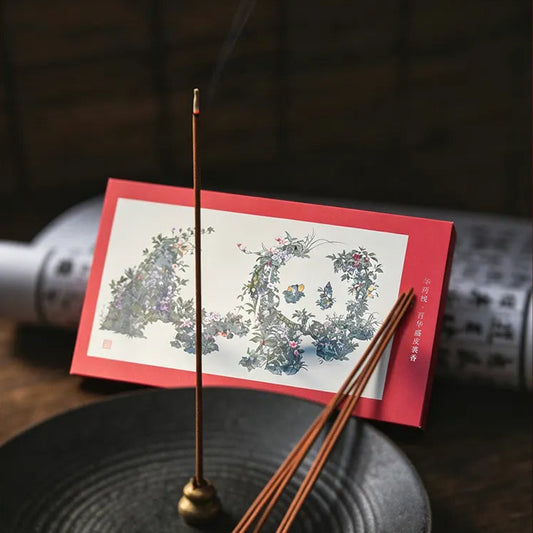
Incense Sticks
Incense sticks are one of the most familiar forms of incense today.
Traditional-style incense sticks can be made by combining powdered aromatic materials with suitable binders and forming them into slender sticks.
Depending on the formulation, a stick may contain a single principal aromatic material or a more complex blended formula.
For modern users, incense sticks are one of the simplest ways to experience traditional botanical fragrances at home.
Incense Coil
Incense coil, or spiral incense, is formed into a continuous spiral rather than a straight stick.
Its shape allows a longer length of incense to burn within a relatively compact area.
Beyond its practical function, coil incense also has a distinctive visual quality. It can be displayed in an incense holder and appreciated as an object before it is even lit.
For people who enjoy longer incense sessions or want a more decorative presentation, coil incense offers an alternative to straight sticks.
Incense Powder and Incense Seals
Before modern stick incense became the dominant format in many markets, incense could also be used in powdered and molded forms.
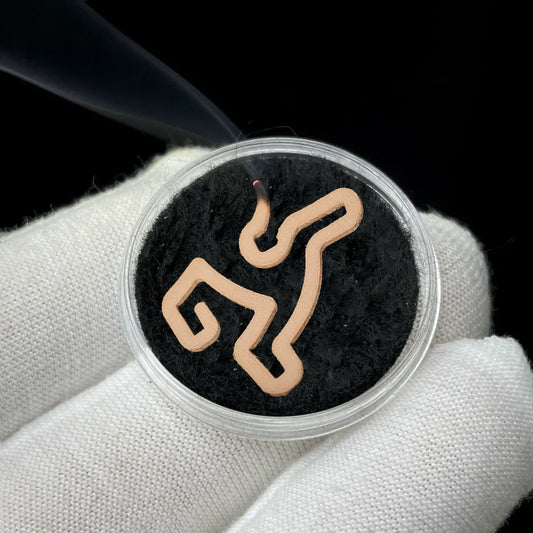
One traditional method involves arranging incense powder into a pattern or character and heating it gradually rather than burning a conventional stick.
These practices require more preparation and specialized tools, making them particularly interesting to people who want to explore incense as a cultural practice rather than simply as home fragrance.
Incense Sachets
The xiangnang (香囊) is one of the most recognizable forms of traditional Chinese personal fragrance.
A xiangnang is generally understood as a scented sachet containing aromatic materials and carried or worn on the body. Textile sachets became associated with clothing, personal fragrance, gifts, festivals, and decorative craftsmanship.
Historical evidence also shows that the term xiangnang was used for specialized incense-burning vessels during the Tang period, demonstrating that the history of the term is more complex than the modern cloth sachet alone.
Today, the scented sachet remains one of the easiest traditional fragrance forms to adapt to modern life.
Unlike burning incense, a non-burning sachet can provide a more subtle personal or ambient fragrance without creating smoke.
He Xiang Beads and Wearable Incense
Blended incense can also be shaped into beads and other non-burning forms.
Modern Incense beads are made from blended aromatic materials and can be worn as bracelets or other forms of personal adornment.
This format is particularly interesting because it changes the way incense is experienced.
Instead of lighting the material, the wearer carries the fragrance as a personal object.
Panda Incense extends this idea into contemporary wearable forms, including incense bracelets, necklaces, and earrings.
These should be understood as modern interpretations of the broader Chinese tradition of carrying and wearing fragrance, rather than presented as though every contemporary jewelry format existed in exactly the same form in ancient China.
That distinction matters.
Tradition does not have to mean reproducing the past literally. It can also mean understanding an old material culture well enough to reinterpret it responsibly for contemporary life.
How Was Incense Used in Traditional Chinese Culture?
Traditional Chinese incense served many different purposes, and reducing it to “relaxation” misses much of its cultural history.
Ritual and Religious Practice
Incense has long been used in Chinese religious and ceremonial settings, including Buddhist and Taoist contexts and forms of ancestor veneration.
Here, fragrance was part of a larger ritual environment rather than simply a method of making a room smell pleasant.
Personal Fragrance
Aromatic materials could also be carried or worn.
Scented sachets provided a portable form of fragrance, while aromatic materials were incorporated into personal objects and clothing.
The history of the xiangnang demonstrates how closely fragrance and personal adornment could be connected.
The Scholar's Studio
During the Song period and later, incense became closely associated with literati culture.
The scholar's studio was not simply a place to work. It could also be a space for appreciating books, paintings, calligraphy, tea, music, and fragrance.
Incense therefore became part of a broader culture of attention and appreciation.
This is an important historical foundation for the way incense is sometimes used today in reading rooms, studios, and quiet personal spaces—but the modern practice should not be mistaken for an exact recreation of historical scholar culture.
Tea and Social Gatherings
Incense could also accompany social and cultural activities.
The relationship between fragrance, tea, conversation, and appreciation of objects became especially significant in later Chinese elite culture.
Rather than treating incense as an isolated product, it is more useful to understand it as one part of a broader sensory culture.
Traditional Chinese Incense vs. Modern Home Fragrance
Modern home fragrance is usually designed around convenience and a clearly defined scent profile.
Traditional Chinese incense often begins somewhere else: with the character of the aromatic material itself.
This difference changes how the fragrance is experienced.
A modern fragrance product might aim to produce a familiar result such as “vanilla,” “fresh linen,” or “rose.”
A botanical incense may instead ask you to notice the material: the warmth of sandalwood, the resinous depth of agarwood, the brightness of frankincense, or the layered character of a blended formula.
Neither approach is inherently superior.
But if you are interested in traditional Chinese incense, learning to recognize individual materials is one of the most rewarding places to begin.
How to Bring Traditional Chinese Incense Into a Modern Home
You do not need to recreate a historical Chinese incense ceremony to appreciate the tradition.
Start with the material and choose a form that fits your lifestyle.
For Everyday Fragrance
A simple incense stick can be an accessible introduction to botanical incense.
Choose a material you already enjoy and pay attention to how its aroma develops from the beginning to the end of the burn.
For Longer Incense Sessions
Coil incense offers a longer, more continuous format and can work well when you want incense to become part of a longer period of reading, tea, or quiet time.
For Personal Fragrance
A scented sachet or wearable incense piece offers a non-burning alternative.
An incense bracelet, necklace, or other wearable form allows fragrance to become part of a personal object rather than something that fills an entire room.
For Exploring Traditional Formulation
If you want to understand Chinese incense more deeply, explore blended incense and He Xiang.
Instead of asking only whether you like a fragrance, begin asking:
- Which materials can I identify?
- How does the fragrance change over time?
- What happens when several materials are combined?
- Do I prefer woody, resinous, herbal, spicy, or floral profiles?
This changes incense from a generic home fragrance into something you can actually learn.
How to Choose Traditional Chinese Incense Today
The modern incense market can make traditional products difficult to evaluate because words such as “natural,” “traditional,” “herbal,” and “handmade” are often used as marketing language.
If you want a product with a genuine connection to botanical incense traditions, look beyond the packaging.
Look at the Materials
Does the brand tell you what is actually in the incense?
Specific materials such as sandalwood, agarwood, frankincense, herbs, roots, and spices give you much more information than a vague description such as “ancient Chinese formula.”
Understand the Form
Different forms offer different experiences.
Choose sticks for simplicity, coils for longer sessions, sachets for non-burning fragrance, and wearable incense for a more personal format.
Look for Ingredient Transparency
A responsible incense brand should be able to explain its materials and, where relevant, how its products are formulated.
“Traditional” should describe more than the packaging.
Pay Attention to Craftsmanship
The same aromatic materials can behave differently depending on how they are processed, blended, formed, and dried.
Craftsmanship is part of the incense experience—not simply a story added to the product afterward.
How Panda Incense Interprets Traditional Chinese Incense Today
At Panda Incense, we are interested in the part of Chinese incense culture that begins with the materials themselves.
Aromatic woods, resins, herbs, roots, flowers, and spices can each offer a distinct character. Blended formulas can bring those materials together, while different formats allow fragrance to become part of different parts of daily life.
That is why our collection is not limited to one type of incense.
You can explore traditional-style incense sticks and coils for burning, blended incense for experiencing more complex formulas, and wearable or non-burning forms such as incense bracelets, necklaces, earrings, and sachets.
The goal is not to reproduce ancient Chinese life exactly.
It is to carry forward an appreciation for aromatic materials and craftsmanship while creating forms that make sense in contemporary homes and everyday life.
Explore Panda Incense's traditional Chinese incense collection →
Frequently Asked Questions
What is traditional Chinese incense?
Traditional Chinese incense refers broadly to aromatic materials, formulations, objects, and practices that developed within Chinese cultural history. It includes botanical materials such as woods, resins, herbs, roots, flowers, and spices, as well as forms such as sticks, coils, powders, sachets, and blended incense.
What is Chinese herbal incense?
Chinese herbal incense can refer to incense made from botanical aromatic materials, including herbs, roots, woods, resins, flowers, and spices. Some of these materials overlap with traditional Chinese materia medica, but “herbal incense” should not automatically be interpreted as a medicinal product.
What is He Xiang?
He Xiang (合香) refers to blended or combined incense, in which multiple aromatic materials are formulated together to create a particular fragrance. For a deeper explanation of its history and craftsmanship, see our dedicated He Xiang guide.
What incense was used in ancient China?
Historical Chinese incense included a wide range of aromatic woods, resins, herbs, roots, spices, and other materials. It was used in different forms, including powders, pellets, cakes, sticks, and other incense-burning formats, depending on the period and context.
What is a Chinese incense sachet?
A Chinese incense sachet, or xiangnang (香囊), is a portable scented object traditionally associated with personal fragrance and adornment. Textile sachets could contain aromatic materials and be worn or carried. Historical evidence also documents specialized incense-burning vessels called xiangnang during the Tang dynasty.
What is coil incense?
Coil incense is incense formed into a spiral rather than a straight stick. Its compact shape allows a longer length of incense to burn within a relatively small area.
Are incense beads traditional Chinese incense?
Blended incense beads are best understood as a non-burning form of blended incense that draws on the broader Chinese tradition of combining and carrying aromatic materials. Contemporary bracelets, necklaces, and other jewelry forms should be understood as modern adaptations rather than assumed to be identical to historical objects.
How do you use traditional Chinese incense?
The simplest approach is to choose a form that fits your purpose. Burn incense sticks or coils in an appropriate holder and well-ventilated space. For non-burning fragrance, use a sachet or wearable incense form. If you are exploring the tradition, begin by paying attention to the individual materials and how their fragrance develops.
What is the best Chinese incense for beginners?
Sandalwood is a straightforward starting point if you enjoy warm, woody fragrances. Frankincense offers a more resinous profile, while blended incense provides an opportunity to explore how multiple materials work together. For a non-burning introduction, an incense sachet or wearable incense piece can be an accessible option.