He Xiang: What Chinese Blended Incense Actually Is
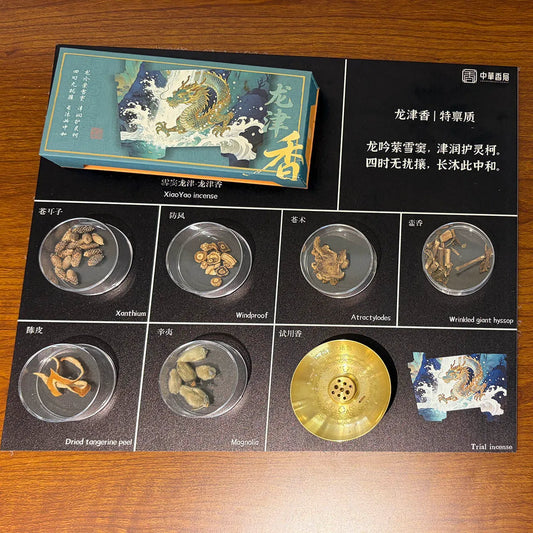
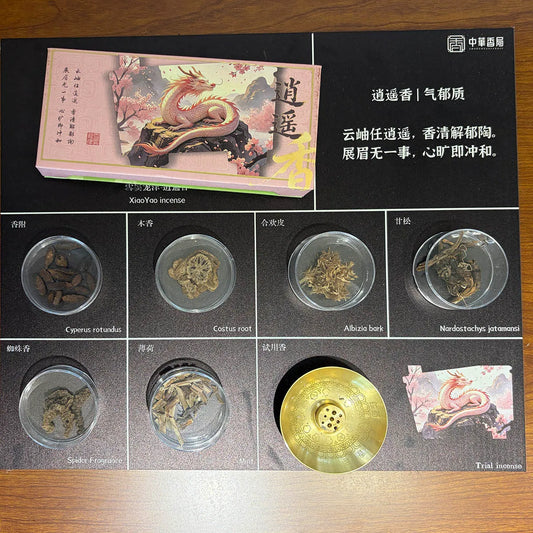
Read the ingredient list on a box of Chinese blended incense and it reads less like a perfume than a pharmacy receipt: sandalwood, clove, atractylodes, patchouli, licorice root, angelica. They are Chinese medicinal herbs, the same materia medica a pharmacy dispenses, weighed out here for how they smell, not for how they are prescribed. In Chinese these aromatic materials are called yao xiang (药香). How that world is organized is on our guide to the four material families.
What the word asks for
The character is 和: to bring into accord, to make two things sit well together. It is the character in 和谐 (harmony) and 和睦 (getting along). A second character, 合, is pronounced the same and means to combine.
Both appear in the Song manual quoted below, used for the same operation. 「合香之法」 heads its section on blending. 「新和香必須窨」 opens its section on resting a fresh blend. One book, two characters, the same work, which is why we treat the difference between them as a standard we hold, not a rule recovered from antiquity.
合 is the combining. 和 is what has to happen afterward, and it decides whether you end up smelling one thing or several. The manual writes that goal with 合, in one line: the method of blending is prized for making all the aromas one body (合香之法貴於使衆香咸為一體).
A formula from the Song dynasty
The shortest way to show what that means is to read one. This comes from the Chen Shi Xiang Pu, compiled by Chen Jing of the Song dynasty and completed by his son, gathering eleven earlier manuals. The formula is attributed to Su Shi, and it is called Su Neihan Pin Ya Xiang, the poor official's incense, because a formula of this kind would normally be led by agarwood, and this one is led by sandalwood instead:
White sandalwood, four taels: cut into thin slices, mixed with honey, stirred in a clean vessel over heat until dry, adding honey as it goes, stirred without stopping, until the color turns dark brown. Take care not to scorch it. Frankincense, five grains: wrapped in raw silk and simmered with a cup of good wine until the wine has reduced by half. Musk, one measure. Scrophularia, one qian.
Grind the sandalwood coarse, then grind the musk fine and add it to the sandalwood, add wheat bran charcoal to adjust the color, blend with the scrophularia and frankincense until even, work into a paste with refined honey, press it into a porcelain vessel, seal it, and bury it in the ground for one month.
Each material is prepared before it meets the others. The sandalwood is honey-baked and stirred until it changes color. The frankincense is simmered in wine. Neither is decoration: honey-baked sandalwood is rounder than raw, and wine-cooked frankincense loses the sappy green edge it arrives with. Clove comes in aggressive, atractylodes dry and dusty, resins sharp. Chinese herbal practice has a vocabulary for this, the same pao zhi (炮制) discipline a pharmacy applies to medicinal herbs: dry-frying, honey-baking, wine-processing, steaming. Each one changes how a material behaves under heat, and the work is done material by material, before anything is combined.
Every material is given a rank. The structure is borrowed from herbal prescribing, a hierarchy called jun chen zuo shi (君臣佐使): one chief sets the direction, the deputies build on it, the assistants handle what the chief cannot, and the envoy carries the whole and smooths the joins. In Su Shi's formula the sandalwood is the chief and the rest exist in relation to it. Nothing is there to show off. A maker who wants more frankincense does not pour in more of it, because the frankincense has to be carried by the sandalwood, and rebalancing the sandalwood is the actual work. Ten materials with no hierarchy smells like ten materials.
Then it is left alone. This is the step most often skipped and the only one that cannot be done faster. The manual states it as a rule: a newly made blend must be rested, sealed in a non-porous vessel with waxed paper and set into a hole in the floor of a quiet room, then taken out a month or more later. Freshly mixed powder smells like its ingredient list. Given weeks in a closed vessel, materials that were only sitting next to each other start exchanging: the sharp edges round off, the gaps between one material and the next close up, and a smell develops that belongs to the formula, not to any of its parts. The Song manual asked for a month. Ours rest in sealed earthenware for twelve before they are formed into sticks. Weighing, milling, kneading, and that rest are set out step by step on our production process page.
Why most incense is not made this way
Because of that last step. Resting ties up vessels for months, floor space that earns nothing, and capital locked in powder that cannot ship yet. Mixing takes an afternoon. A market that rewards turnover produces the fast version, and once the fast version has been on shelves long enough, it becomes what the word means. Two boxes can carry the same label while only one was harmonized, and the label will not tell you which.
Telling them apart at home takes one whole stick and about twenty minutes. That test is on our single-note vs blended incense page.
He xiang next to the incense you already know
Single-material incense. A single material sits outside the he xiang standard, not below it. Burning one wood by itself is the older practice and a different job: a piece of agarwood on its own tells you where it grew, how much resin it carries, how it behaves as the ember moves down the stick, and there is nothing to balance because nothing else is in the room. The usual way to arrange the two is a ladder with single materials on the bottom rung. A ten-material formula that was only mixed smells less composed than one piece of good wood burned alone, so the ladder has it backwards. If you want to know what sandalwood actually smells like, a single-material stick is the only honest reference, and two sticks sold under that name can differ completely. The reasons are on why two sandalwood sticks can smell completely different.
Dipped sticks. Much of the incense sold in North America is a bamboo or cellulose splint soaked in fragrance oil. The smell barely changes from the first minute to the last, because there is one aromatic source and nothing in it that develops. That is a serviceable way to make a room smell of something, and it is not what a formula does.
Three to start with
Flow Free (Tong Qu, 通衢) is the resin-heavy end: frankincense and myrrh carrying the base, cassia and angelica warming the top, ligusticum through the middle. Deep and slow, better in a large room than a small one.
Sun Warmth (Xu Yang, 煦阳) leads with cinnamon bark and clove, mugwort and dried ginger behind them, benzoin closing it. Spiced and warm, the one people reach for on a cold evening.
Ease Balance (Chang Su, 长苏) is the quiet one, benzoin as chief with agarwood as deputy and patchouli through the middle. It will not announce itself across a shop. Up close it is even from end to end.
These are three of nine. The nine were designed around the nine constitutions logic, not around scent families. All nine are on the Xuedou Dragon Stream page.
Frequently Asked Questions
Is he xiang just another word for blended incense?
On packages, effectively yes, and that is the problem. Blending is the physical act of combining materials. He xiang is a claim about what was done afterward. Plenty of products labeled he xiang were only blended.
Are these the same herbs a Chinese pharmacy dispenses?
Yes. Atractylodes, angelica, licorice root, and patchouli are stock items in any Chinese pharmacy. What differs is why they are being weighed out: dispensed to be prescribed, or measured for what they contribute to a smell.
Why does the same formula smell a little different from one box to the next?
The materials are agricultural. Sandalwood from a different grove, resin harvested in a different season, a root processed on a humid day: all of these shift the starting point, and a formula has to be adjusted, not simply repeated. Resting absorbs some of that variation, which is one of the reasons it is done.