The Timeless Fragrance: Six Domains of Chinese Incense Culture
When humans first mastered fire, incense became intertwined with human existence. Chinese incense culture traces its roots back to the liao‑ji (fire‑offering rituals) of the Neolithic Age. Ancient ancestors burned aromatic plants, believing rising smoke could connect humanity with the divine. From these simple sacred ceremonies, six distinct domains of incense practice gradually took shape: Confucian, Buddhist, Taoist, medicinal, imperial‑court, and folk customs.

Chinese incense spread hand‑in‑hand with ancient trade and cultural exchange. Both overland and maritime Silk Roads — the very routes that brought Buddhism to China by land and sea — largely overlap with today’s Belt and Road Initiative. Along these cultural and commercial corridors, spices and aromatic ingredients traveled far and wide. Back in the Song Dynasty, Hong Kong served as a major trading hub for aromatics, which is where its name originated.

1. Confucian Incense: Ritual and Self‑Cultivation
Core spirit: Incense defines etiquette; incense cultivates virtue.
Originating from pre‑Qin sacrificial fire ceremonies and perfume‑wearing customs, Confucian incense was integrated into court rituals during the Han‑Wei dynasties. By the Song‑Ming era, it branched into official ceremonial incense and literati incense practice.
Within Confucian thought, fragrance symbolizes moral character and social hierarchy. Burning incense was not merely for pleasant scent. It reinforced ethical values, social order, and personal self‑improvement for scholars and officials.
2. Buddhist Incense: Offerings and Purification of Mind
Core spirit: Incense honors the Buddha; incense calms the mind.
Buddhist incense was introduced to China from India in the Eastern Han Dynasty. In Buddhist philosophy, smoke acts as a bridge between the mortal world and the spiritual realm, supporting meditation and spiritual practice.
Two well‑established ritual systems developed in China: the Han‑Chinese Xing‑Xiang (processional incense ceremony) in temples, and the Tibetan‑influenced Sang (smoke‑offering) tradition. Strict rituals use fragrance to clear mental distractions and help practitioners focus inward.
3. Taoist Incense: Communing with the Sacred & Clearing Negative Energy
Core spirit: Incense connects to immortals; incense dispels impurities.
Rooted in native Chinese religion and ancient nature worship, Taoist incense evolved from pre‑Qin fire sacrifices to heaven. It became formalized in Taoist rites in the Eastern Han Dynasty, with systematic incense catalogs compiled in the Tang Dynasty.
Taoists believed incense smoke rises to communicate with celestial beings and follows the five‑element cosmology. Beyond spiritual ceremonies, aromatic blends were also used to clear stagnant energy and support physical well‑being, uniting spiritual reverence with practical wellness.
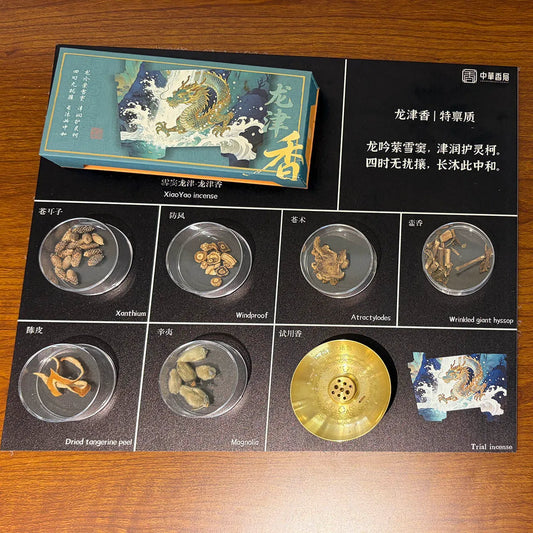
4. Medicinal Incense: Aromatherapy from Traditional Chinese Medicine
Core spirit: Herbs and aromas share the same medicinal origin.
Medicinal incense began with prehistoric smoke fumigation for epidemic prevention. Its theoretical framework matured through the Qin‑Han and Song‑Tang periods, built entirely on Traditional Chinese Medicine principles.
Practical methods include burning, wearing aromatic sachets, oral preparations and moxa‑aroma therapy. Treatments work both externally and internally. Custom aromatic formulas were used for disease prevention, physical balance and holistic wellness.
5. Imperial‑Court Incense: Luxury and Symbol of Sovereign Power
Core spirit: Opulent royal use, symbolizing rank and authority.
Imperial‑court incense grew from pre‑Qin royal sacrificial customs. It reached its peak in the Tang‑Song dynasties and became extraordinarily elaborate in the Ming‑Qing period.
Only rare, tribute‑grade aromatic materials were selected for imperial use, paired with exquisitely crafted incense burners and utensils. Incense served grand state ceremonies, daily royal wellness, and interior decoration. It represented the supreme status and ceremonial grandeur of imperial power.
6. Folk Incense: Blessings for Everyday Life
Core spirit: Pray for good fortune; ward off illness and misfortune.
Folk incense carries the strongest everyday‑life vibe among the six traditions. Stemming from ancient grassroots sacrifices and disease‑prevention customs, it is deeply embedded in Chinese festivals and solar‑term cycles.
Simple, affordable and regionally diverse folk incense accompanies Lunar New Year, Dragon Boat Festival and other seasonal occasions. Ordinary households burn incense to pray for safety, health and family happiness. Full of earthly warmth, it is the most widely‑lived‑out inheritance of Chinese incense culture.
From primitive fire‑offering smoke to these six rich traditions, Chinese incense weaves together ritual ethics, spiritual belief, herbal wisdom and folk life. Fragrance has traveled through thousands of years of history and still resonates in modern‑day culture.