Agarwood vs. Medicinal Incense: What's the Relationship?
Visitors to incense museums keep asking a version of the same question: is agarwood a kind of medicinal incense? And which of the two ideas covers more ground?
The short answer: medicinal incense is the wider category, and agarwood moves freely inside it. Agarwood is a single material that can stand entirely on its own. Medicinal incense is a formula-based craft, and agarwood happens to be one of the materials those formulas reach for most often. The interesting part is what turns a pile of materials into a formula, and Chinese has two different characters for that, which this page will untangle.
What medicinal incense is
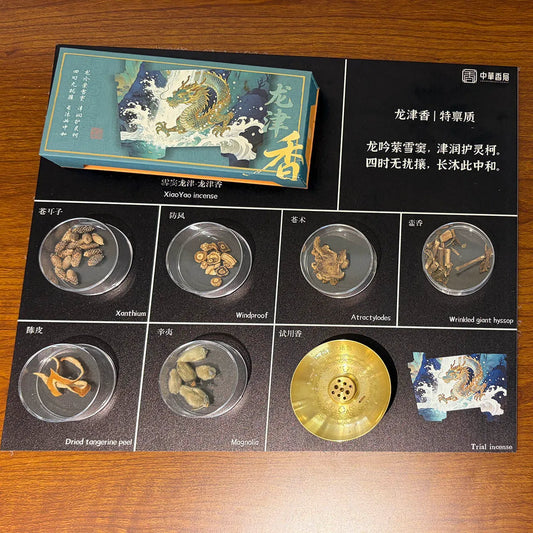
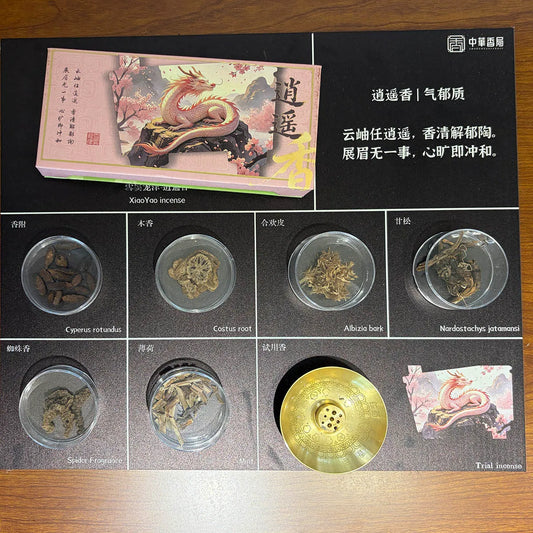
Medicinal incense, yao xiang (药香) in Chinese sources, is incense built from Chinese medicinal herbs: the aromatic materials drawn from the same shelf a pharmacy dispenses. The herbs form the base. They are what put the word yao, medicine, in the name, and they were chosen, graded, and processed by formulary rules rather than by kitchen habits.
A blend made purely from herbs, though, tends to smell green, heavy, and faintly like a medicine chest. Classical makers knew this and folded aromatic woods and resins into the formula to correct it: agarwood, sandalwood, rosewood, and, in some traditions, cliff cypress. In the classical understanding, the herbs defined the formula's recorded character, while the fragrant woods shaped how it actually smelled in the room. Where each of these materials sits across the whole classical palette is mapped in our guide to the four material families.
Two characters, both read hé
Here is the distinction most English writing on Chinese incense never reaches. The craft of blending incense has two names in Chinese, and they are near-homonyms. One is 合香, hé xiang, written with the character for joining: materials put together. The other is 和香, also hé xiang, written with the character for harmony: materials brought into balance with each other.
The old texts were loose about the two and often swapped them. Working incense makers today read them as two levels of the craft, and the classical sources support that reading.
The clearest statement of the method survives in the Chen Shi Xiang Pu, Chen Jing's Song-dynasty incense manual, and is carried again in the Ming encyclopedia Xiang Cheng, volume thirteen:
合香之法,贵于使众香咸为一体。麝滋而散,捣之使匀;沉实而腴,碎之使和;檀坚而燥,揉之使腻。比其性,等其物而高下之,如医者之用药,使气味各不相掩。
The method of blending prizes making all the aromatics one body. Musk is rich but scatters, so it is pounded until even. Agarwood is dense and unctuous, so it is broken fine until it agrees. Sandalwood is hard and dry, so it is kneaded with honey until it turns smooth. Compare their natures, weigh their amounts, and rank them high and low, as a physician uses medicines, so that no aroma drowns out another.
Notice the last phrase: as a physician uses medicines. That is the whole gap between the two characters. A mixture just combines. A formula weighs what each material is, checks what too much of it would do, and adjusts everything else around it.
The earliest surviving writing about blended incense makes the same point by example, five centuries earlier. Fan Ye, the historian of the Later Han, wrote a preface for a book of incense formulas in the fifth century, preserved in the History of the Song, chapter sixty-nine:
麝本多忌,过分必害;沈实易和,盈斤无伤。
Musk comes with many cautions; past a certain amount it harms. Agarwood is steady and easy to harmonize; a full catty does no harm.
That is dosage logic, applied to incense, in the earliest known text on the subject. The preface happens to be a satire of court officials, with each incense material standing in for a politician. It survived because it is also the first place the balancing logic of herbal prescribing shows up in an incense formula.
This is where the two characters stop being trivia. Plenty of incense on the market is 合香 in the plain sense: materials measured, mixed, and pressed. The other level, 和香, takes the physician's question seriously. It works with the chief, deputy, assistant, and envoy structure a herbal prescription uses. It processes each material before it enters the blend, exactly because raw materials arrive with harsh edges. And it leaves the finished blend to age in clay jars, because time rounds off what kneading cannot. That is the standard our own workshop works to, and it is the honest meaning of "neutralizing the natures": the recipe exists so that no single material runs hot, so the blend as a whole lands even.
Where agarwood sits
Agarwood plays on both sides of the line. On its own, it is the classic single-ingredient incense: one material, graded and burned straight. The Ben Cao Gang Mu records it in the wood section under its own entry, noting that the heartwood is dense enough to sink in water, which is where its Chinese name, chen xiang, the sinking aromatic, comes from.
Inside formulas, it is everywhere. Open the recipe section of the Xiang Cheng, volume fourteen, and the court recipes read like a roll call: the Han Jianning palace blend opens with agarwood, the Tang Kaiyuan palace blend builds on it, Yang Guifei's chamber blend and Lady Huarui's blend both list it among the chiefs. Agarwood is not the alternative to medicinal incense. It is one of its oldest team players, and the one the formularies trusted to be easy to harmonize.
This page describes a historical craft and its classical sources, and we present all of it as history. How any stick, single-wood or blended, smells in your own room is yours to judge, and that is the claim we stand behind.