Chinese Incense Herbs vs. Kitchen Spices: What's the Difference?
Open a traditional Chinese incense recipe and you will meet old kitchen friends. Star anise. Cinnamon bark. Clove. The same jar that seasons a braised dish also supplies a classical blend, and this overlap is where most English-language writing on Chinese incense goes wrong. It frames the two as separate worlds, one for taste and one for health. The surviving recipes tell a different story: the materials overlap heavily, and what actually separated the two traditions was selection, processing, and a smell theory written down more than two thousand years ago.
This page explains that theory, where it comes from, and what it still tells you when you pick up a stick today.
Same plant, different job
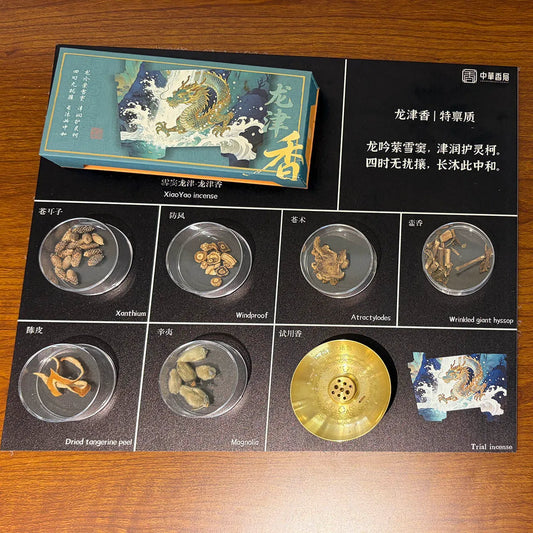
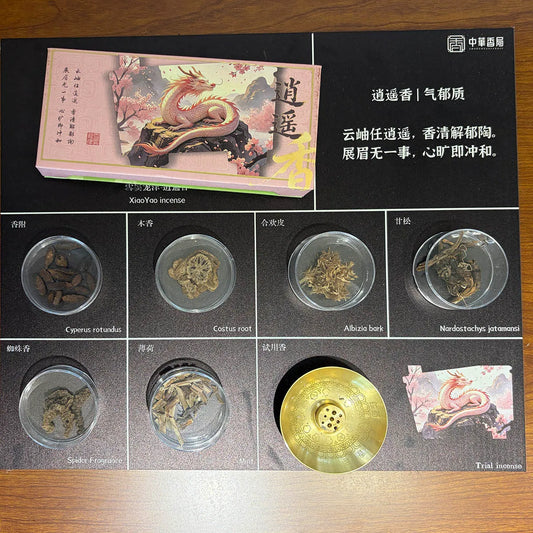
The kitchen buys cinnamon for its taste. An incense workshop buying the same bark grades it by scent character instead, then processes it the way a formulary prescribes: dry-fried, honey-baked, or aged, depending on the blend it is entering. Chinese incense making has a name for materials used this way, xiang yao (香药), aromatics that enter a formula. The word matters. Yao places them inside the classical herbal system, where each material is recorded with its nature, flavor, and traditional function. The kitchen treats the same shelf of spices as seasoning and stops there.
So the honest version of the "spice versus herb" question is this: the overlap is real, and the divergence is in the craft. A cinnamon quill chosen for a stew is picked for sweetness. A cinnamon quill chosen for an incense formula is picked for how its warmth behaves when blended with sandalwood and smoked rather than simmered. Same plant. Different tradition, different hands, different questions asked of the material.
Five smells, five organs
The theory behind those questions appears in one of the oldest chapters of the Huangdi Neijing (《黄帝内经》), the foundational text of Chinese medicine. In the Jinkui Zhenyan Lun chapter of the Suwen (《素问·金匮真言论》), each organ is paired with a smell in a single sweep: "its odor is sao (臊)" for the liver, "jiao (焦)," scorched, for the heart, "xiang (香)," fragrant, for the spleen, "xing (腥)," fishy, for the lungs, and "fu (腐)," rank or fermented, for the kidneys.
Two things worth knowing about that list.
First, the list is a taxonomy. The chapter is sorting the whole world of smells into five families and attaching each to an organ system, the same way it attaches five colors, five grains, and five notes of the scale. Nobody was instructed to burn something fishy for their lungs. Classical readers took the five-smell scheme as a way of classifying.
Second, look at where incense culture actually concentrated. Of the five families, the tradition built its recipes overwhelmingly from two: xiang, the fragrant family classically associated with the spleen and stomach, and jiao, the toasted, resinous family associated with the heart. Flowers, woods, and resins on one side; aged, warmed, and roasted aromatics on the other. That preference is visible in any surviving formulary, and it is the practical trace of this theory inside real recipes. Where those two families sit inside the whole classical palette, from plant aromatics and tree resins to animal materials and minerals, is mapped out in our guide to the four material families.
And five tastes
The same classical system also sorted flavors into five and assigned each an organ. The Xuanming Wuqi chapter of the Suwen states it in one line: sour enters the liver, pungent enters the lungs, bitter enters the heart, salty enters the kidneys, sweet enters the spleen.
For herbal decoctions this was working doctrine: a material entered the body by taste, so taste decided where its effect was understood to land. Incense took the same framework and shifted the entry point from tongue to nose. An aromatic material in a blend still carried its recorded nature and flavor in the formularies, and classical writers reasoned about it in the same vocabulary, but the delivery was scent in smoke rather than taste in a bowl. That shift, from a swallowed remedy to a room filled with fragrance, is the fork in the road where aroma culture walked away from the kitchen and the pharmacy and became its own craft.
Smell and taste were two of the maps classical medicine drew over the body. A much later one, still taught in Chinese medicine schools today, sorts people themselves into nine body constitutions, and that framework is the design logic behind our own nine-blend lineup.
What this means when you light a stick
When you read that a blend leads with sandalwood and supports it with clove, you are looking at the far end of a very long chain: a material recorded in the herbal canon, graded for scent rather than taste, processed by hand, and slotted into a formula whose logic was first written down in chapters like the two quoted above.
One boundary note, in plain language. This page describes a historical classification system, and we present it as history. How a stick smells in your room is something you can judge yourself, and that is the claim we stand behind.