Aromatherapy for Sleep: How a Calming Bracelet Supports Your Wind-Down Routine
Here's a number that should keep you up at night (if you could fall asleep): approximately 50-70 million US adults have chronic sleep and wakefulness disorders. The CDC reports that about 1 in 3 American adults don't get enough sleep on a regular basis.
The sleep industry is enormous — medications, supplements, white noise machines, weighted blankets, sleep tracking wearables. But many of these approaches miss something fundamental: the transition into sleep isn't a switch you flip. It's a process your nervous system has to be guided through.
Scent can guide that process. The Dream Drift incense bracelet is formulated with the TCM principle of 安神通气 — "calming the spirit and clearing energy pathways." Here's what that means in practice, and why a wearable scent works differently from a lavender pillow or a diffuser on your nightstand.
Why Scent Is Uniquely Suited for Sleep
Of all your senses, smell has the most direct connection to the brain structures that govern relaxation and sleep. The olfactory nerve connects directly to the limbic system — specifically to the amygdala (emotional processing) and hippocampus (memory) — without passing through the thalamus first.
This means scent can shift your emotional state before you've consciously processed what you're smelling. For sleep, this matters because the barrier between wakefulness and sleep isn't primarily cognitive — it's physiological. You can't think your way to sleep. You have to shift your autonomic nervous system from sympathetic activation (alert, vigilant, "fight or flight") to parasympathetic rest ("rest and digest").
Scent reaches the limbic system within seconds of inhalation. A calming scent can begin reducing sympathetic activation almost immediately — lowering heart rate, reducing cortisol production, and signaling to the brain that the environment is safe enough to release vigilance.
What Research Says About Scent and Sleep
Lavender
The most-studied scent for sleep. Multiple studies have found that lavender aromatherapy can improve sleep quality, reduce sleep onset latency (time to fall asleep), and increase the percentage of deep sleep. One frequently cited study found that lavender oil exposure increased the percentage of deep sleep and reduced wake-after-sleep-onset.
Sandalwood
Research suggests sandalwood scent increases alpha brain waves — the pattern associated with a meditative, relaxed-but-aware state that precedes the transition into sleep. Sandalwood is a key ingredient in many traditional sleep-supporting incense formulas.
The Limitation of Existing Research
Most sleep-scent studies use isolated essential oils in controlled laboratory settings. They don't replicate the real-world experience of wearing a complex 15-to-28-herb formula throughout the evening. But the underlying mechanism — olfactory-limbic access to the emotional brain — is the same regardless of the delivery method.
Honest framing: Aromatherapy is a complementary approach, not a treatment for insomnia or sleep disorders. If you're experiencing chronic sleep problems — difficulty falling asleep, staying asleep, or excessive daytime sleepiness — consult a healthcare provider. Sleep disorders are medical conditions that require proper diagnosis and treatment.
Why a Bracelet Works Differently From a Diffuser
Here's the practical problem with diffusers for sleep: you have to turn them on, fill them with water, add oil, and then they run for a set period. If you wake up at 3 AM, the scent is gone. And the diffuser sits across the room — the scent concentration at nose level, in bed, is diluted.
A wearable bracelet solves both problems:
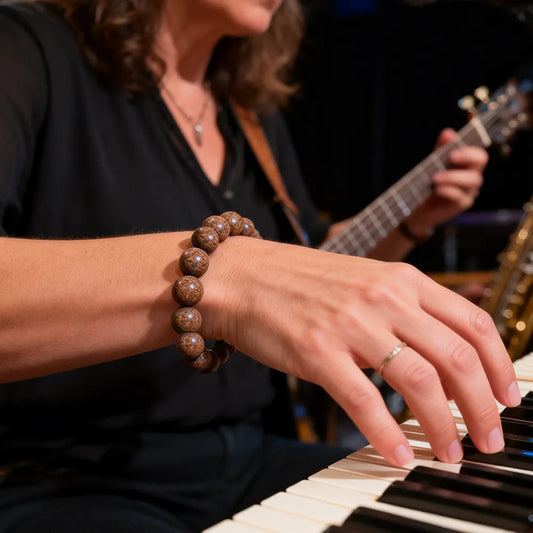
- Continuous, personal-level exposure. The bracelet sits on your wrist, inches from your nose when your hand rests near your face (which is how most people sleep). The scent concentration at the point of inhalation is far higher than from a room-level diffuser.
- Body heat activation. Under blankets, your body warms the beads continuously, releasing a steady stream of aromatic compounds throughout the night. When you wake up at 3 AM, the scent is still there — a sensory anchor that can help you return to sleep without fully waking your cognitive mind.
- The tactile dimension. Rolling the beads between your fingers provides a tactile grounding technique — a repetitive, rhythmic motion that calms the nervous system through a different channel than scent. This dual-sensory approach (touch + smell) is more effective than either alone.
The Dream Drift Incense Formula
The Dream Drift incense bracelet's TCM classification is 安神通气 — two concepts worth unpacking:
安神 (calming the spirit): In TCM, "shen" (神) refers to the spirit, consciousness, and mental activity. "Calming the shen" means quieting the mind — reducing racing thoughts, mental restlessness, and the kind of pre-sleep anxiety that keeps you staring at the ceiling. Herbs that "calm the shen" in TCM typically contain compounds with sedative or anxiolytic properties.
通气 (clearing energy pathways): "Qi" (气) refers to the body's vital energy and the pathways it travels. "Clearing qi" means removing stagnation — the stuck, heavy feeling that makes your body feel like it can't relax into sleep even when your mind is tired. This often involves herbs that promote circulation and respiratory openness.
Together, the formula addresses both the mental barrier to sleep (racing mind) and the physical barrier (tense, restless body). This dual approach — calming the mind while opening the body — is what distinguishes a well-formulated incense bead from a simple lavender scent.
Building a Wind-Down Ritual With a Sleep Bracelet
The key to using aromatherapy for sleep is conditioning. If you consistently experience a specific scent during your wind-down routine, your brain begins to associate that scent with the transition to sleep. Eventually, the scent itself triggers the relaxation response — a Pavlovian conditioned response.
Here's how to build that conditioning:
1. Put the bracelet on 60-90 minutes before bed. This gives the scent time to register and gives your nervous system time to transition. Don't wait until you're already in bed and frustrated.
2. Pair it with one other wind-down activity. Reading (not on a screen), gentle stretching, journaling, or a warm bath. The bracelet + one activity becomes your "sleep signal" combination.
3. Roll the beads during the wind-down period. The rolling serves two purposes: it intensifies the scent release through friction, and it provides a repetitive tactile motion that itself calms the nervous system. Think of it as a mini-meditation — each bead rolled = one conscious breath.
4. Sleep with the bracelet on (or near your pillow). If you normally wear jewelry to sleep, keep the bracelet on your wrist. If not, place it on your pillow or nightstand. The scent will continue to release slowly through the night.
5. Be consistent. Conditioning takes repetition. Use the bracelet every night for at least two weeks before evaluating its effect. The first few nights, the scent is just a scent. After consistent use, it becomes a neurological trigger for sleep.
Choosing a Sleep-Support Bracelet
Scent profile matters. For sleep, avoid bright, stimulating citrus scents. Look for warm, grounding, earthy, or herbaceous profiles. The scent should make you feel like you're sinking, not rising.
TCM classification. Look for products referencing 安神 (calming the spirit) in their formulation. This indicates the formula was designed for the mental quieting that sleep requires, not just general relaxation.
Built-in fragrance. Essential oil diffusers require setup and maintenance. A herbal incense bracelet has the fragrance built into the bead material itself — no setup, no water, no electricity. Just put it on.
The Dream Drift incense bracelet is formulated for calming the spirit and clearing energy pathways — the TCM principles for quieting the mind and relaxing the body for sleep. Grounding, calming scent profile. Hand-pressed from pure herbal powders. View the Dream Drift Sleep Bracelet →
Frequently Asked Questions
Can aromatherapy help with sleep?
Research on lavender aromatherapy suggests it may improve sleep quality by reducing heart rate and blood pressure and promoting relaxation. The olfactory-limbic pathway connects scent directly to the brain's emotional center, making scent one of the fastest ways to signal your nervous system to shift from sympathetic activation to parasympathetic rest.
How does a sleep bracelet work?
A calming herbal incense bracelet works by providing continuous, low-level aromatic support through body heat. During your evening wind-down, the grounding herbal scent serves as a sensory signal to your nervous system that it's time to transition from activity to rest. Rolling the beads also provides a tactile grounding technique.
When should I wear the bracelet?
You can wear it all the time except touch water because of calming and relaxing scent. You can wear it or put it on the pillow for sleep. Begin wearing the bracelet 1-2 hours before your target sleep time. The scent becomes part of your wind-down ritual, creating a conditioned response: eventually, the act of putting on the bracelet signals to your brain that it's time to shift into rest mode.
Can a dream drift incense bracelet replace sleep medication?
No. Aromatherapy is a complementary approach that may support relaxation and wind-down routines. It is not a treatment for insomnia, sleep apnea, or any sleep disorder. If you are experiencing chronic sleep problems, consult a healthcare provider.