Why the Same Incense Smells Different to Everyone
Have you ever burned an incense stick a friend swore by, only to smell something entirely different — fainter, sharper, or somehow warmer on your end? You are not imagining it. And according to a framework that has existed in China for over two thousand years, what you notice first in a fragrance may say something about the current state of your body.
This article covers both sides: what modern science says about why we each smell the world differently, and how Traditional Chinese Medicine (TCM) has long read scent preference as a form of self-observation. If something in your body feels off for more than a couple of weeks, see a doctor — no fragrance can take the place of one.
First, the science: no two noses are alike
Human beings carry roughly 1,000 olfactory receptor genes, but each of us expresses only 350–400 of them as working receptors. Which ones you express, and in what proportions, varies from person to person — even between identical twins. In practical terms, no two people receive the same chemical message from the same incense smoke.
A famous example is cilantro. People with a non-functional variant of a specific receptor perceive only a soapy note in cilantro and tend to dislike it, while those with the full receptor set pick up its fresh, herbal character instead. The same logic applies to every aromatic compound in incense: sandalwood, clove, agarwood, patchouli. Your receptor lineup decides which notes leap forward and which stay in the background.
Memory adds another layer. The scent regions of the brain sit next door to the regions that handle emotion and memory, so a smell you first met in a happy childhood kitchen lands differently than one you associate with a hospital waiting room. Culture works on top of that: wintergreen reads as "candy" to most Americans and as "liniment" to most Britons.
So far, so familiar. But here is where the Chinese tradition goes a step further.
The TCM view: when a system runs low, the nose speaks up
More than two millennia ago, the Huangdi Neijing (《黄帝内经》, the foundational text of Chinese medicine) sorted the world of smells into five families — 臊, 焦, 香, 腥, 腐 — and attached one to each organ system. We walked through where that list comes from and how classical incense recipes drew on it in our guide to Chinese incense herbs and kitchen spices, so we will not retell it here.
From the same map, the tradition drew a more personal conclusion: when a particular system runs low, the body starts reaching for the scents that answer to it. In other words, a favorite fragrance stops being pure taste and part of you is choosing it for you.
A five-scent self-check
If the five families are new to you, the guide above gives the full map. For this exercise you only need the short version, arranged by what you reach for rather than what each scent is called:
|
Scent family |
Traditional association |
Typical notes you might love |
|
Green & woody (臊) |
Liver / Wood — helps qi move, eases tension |
Pine, cedar, sandalwood, fresh-cut grass, mint |
|
Warm & scorched (焦) |
Heart / Fire — warms circulation, steadies the spirit |
Clove, cinnamon, coffee, toasted grain, mugwort |
|
Sweet & earthy (香) |
Spleen / Earth — settles digestion, grounds overthinking |
Vanilla, baked bread, patchouli, rain on soil |
|
Clean & mineral (腥) |
Lung / Metal — clears and settles the breath |
White tea, citrus peel, petrichor, cool stone |
|
Marine & deep (腐) |
Kidney / Water — restores reserves, calms the cold-tired |
Sea air, seaweed, wet stone, camphor-cool mint |
Read the table again and ask yourself honestly: which column do your favorite candles, teas, and incense live in? For most people the favorites cluster in one corner of the map instead of spreading evenly across all five.
Reading your own pattern
Favorites cluster, but they cluster in different shapes. Three common ones, read through the tradition:
A single loyal row. Some people return to one family for everything: the same sweet-earth candle at the desk, the same earthy blend at night. In the traditional reading, one system is speaking loudest and which family it is decides the story. Loyal to sweet earth? Maybe a busy mind and a temperamental stomach, asking to be settled. Loyal to green woods? Tension looking for a way to move. Loyal to the warm scorched family? Cold hands and a low fire, asking for warmth. Loyal to the cool marine or mineral notes? A body running on empty, asking for rest. One clear voice is the easiest to hear, and the easiest to answer.
A chain of two or three. Count your favorites and you may land on two or three families. In TCM, that is not a glitch. The five systems are drawn as a cycle (五行相生, the generation cycle): wood feeds fire, fire feeds earth, earth feeds metal, metal feeds water, water feeds wood. When favorites run along that cycle, the traditional reading sees connected systems working overtime together, not separate complaints. The below are three sketches of what a chain can look like, offered as traditional readings.
- A wood → fire → earth (green woods, warm scorched notes, sweet earthy ones) sits a classic portrait of the overloaded doer: long hours, a racing mind at midnight, meals eaten standing up, tension parked in the shoulders. A body running on stress reaches for scents that move (wood), warm (fire), and settle (earth), and tends to skip the cool, clean families(mental and water) entirely.
- A metal → water (Clean mineral and deep marine notes) is chosen by the depleted sprinter: someone who pushed hard for months and arrived empty — cold hands, heavy afternoons, craving coolness and quiet. Here the nose is asking for rest.
- The seasonal shifter. Some people's favorite rotates through the year: woods in spring, spice in deep winter, citrus when the air-conditioning season starts. The tradition reads drifting preferences as the map working as intended — the body's needs move, and the nose follows.
One more tip before you start. If you answer all of this in your head, your mood answers for you. Light a real stick, on a few different days, in a few different moods, and jot down what you notice. If your favorite turns out to change from week to week, that is fine — in this framework, a moving favorite just means the body's needs are moving too. Treat it as one more line in your self-observation notes, alongside sleep, appetite, and mood. And a small number of unusual scent cravings (gasoline, paint, strongly rotten smells) can signal a nutritional or medical issue that genuinely needs a doctor — that part is mainstream medicine, not tradition.
Why blended medicinal incense is built for this
Single-note scents give your nose one message. A properly constructed Chinese blended incense (合香, he xiang) gives it five.
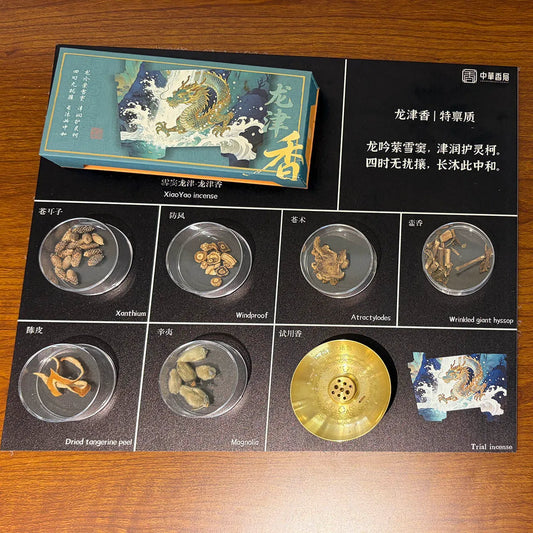
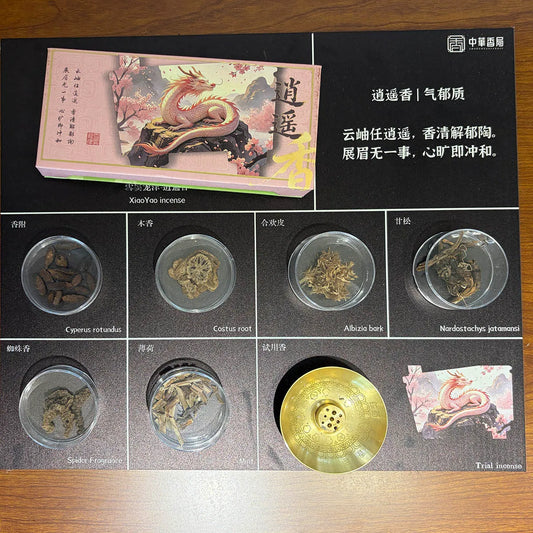
Medicinal incense is the branch of Chinese incense craft that borrows its thinking from herbal medicine. The materials are the same aromatics recorded in the classical formularies, and the blends are composed the way a herbal prescription is: by the old principle of jun-chen-zuo-shi (君臣佐使) — one lead material that sets the character, supporting materials that reinforce it, modifiers that round off the edges, and a carrier that carries the whole formula into the smoke. A decoction delivers the formula in a bowl; a yaoxiang formula delivers it in smoke — the same compositional logic, in a different medium.
Because the layers are deliberately built to answer one another, a blend like this changes with the person inhaling it. Your receptor lineup and your current state decide which layer speaks loudest. One person smells the cedar first; another catches only the sweet warmth underneath it. That variability is a feature, not a flaw — the formula offers a full palette, and your nose picks its own entry point.
The recipes behind our own blends were not invented last year. They come from a lineage of incense making passed down through five generations of one family, a craft recognized on China's national intangible cultural heritage list, and each blend follows those inherited formulas rather than a perfumer's brief. We keep the tradition honest by keeping its scope honest: the formulas are traditional, the materials are graded and processed the old way, and what the stick does for your evening is something you judge yourself.
If you would like to try the self-check, here is a simple exercise with one stick and a quiet room. The structure borrows the pacing of an incense-appreciation session (香席), where the point is to slow down enough to smell deliberately; the interpretation is offered as self-observation rather than tradition:
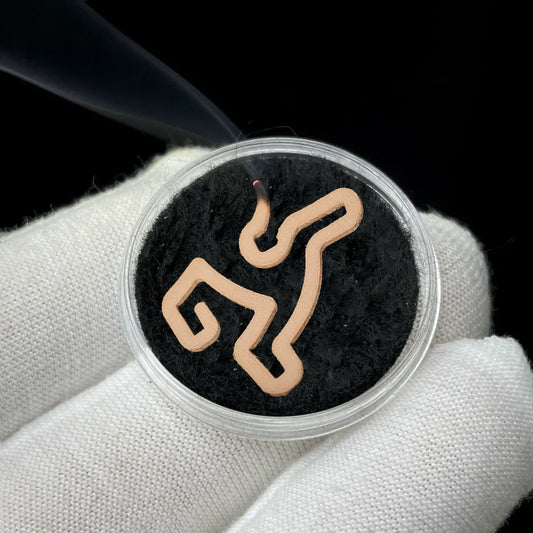
- Light the incense, step back, and let the smoke settle for a minute.
- Take three slow breaths and notice the first note you register — not the strongest, the first.
- Circle back after five minutes and notice what you notice second.
- Note it down. Repeat with a different blend on another day and compare.
Over a few weeks, patterns tend to show up. Whether you read them through the Neijing's five-scent map or simply through your own memory bank, the exercise trains you to notice something most of us ignore: your nose has opinions about what your body needs, and it has been voicing them all along.