Warming Self-Care Rituals for Women Who Are Always Cold
Share
The short version: this is a guide to warming daily care. A foot soak you can time with a stick of incense, the layers and foods that help, a wind-down hour that protects your sleep, and something warm you can wear.
If the first day or two of your cycle is spent waiting for painkillers to kick in, if your hands go numb on the bus and your desk chair has a heating pad permanently installed, this is for you.
A heating pad, an ibuprofen, and a stick of warm-smelling incense are not competing with each other. They sit in the same evening and they do different jobs. That is what daily care means. The warm habits you keep all month are what you have to work with on the days that hurt most.
From traditional Chinese medicine aspect
Chinese medicine has a vocabulary for this exact cluster of symptoms: cold hands and feet, a cold lower abdomen, and cramping that gets better with heat. The classical concept is yang deficiency (阳虚). In TCM's framework, yang is the warm and active quality of the body. When it runs low, the hands and feet go cold first. A related pattern, cold congealing in the uterus (寒凝胞宫), describes cold settling in the lower abdomen.
Two things are worth knowing before you borrow the vocabulary.
1. Cold hands and feet do not automatically mean a cold uterus. Cold hands and feet reflect the whole body's yang reaching the limbs. The term 宫寒 (gong han, cold womb) in TCM refers specifically to the lower abdomen. The two can appear together or separately, and telling them apart takes a real consultation, not a symptom quiz.
2. TCM separates two kinds of cold, and they call for different habits. Excess cold (实寒) comes from outside, through cold exposure or iced drinks during your period. It tends to arrive suddenly, and the cramping clearly improves with heat. Deficiency cold (虚寒) builds slowly from low yang itself. It shows up as a dull ache that likes pressure and warmth, a pale or scanty flow, fatigue, and cold that never quite leaves. The first calls for avoidance. The second calls for steady rebuilding, which is where daily ritual comes in.
Where 药香 fits: daily care, not medicine
The Chinese category for what we make is 药香 (yào xiāng), sometimes translated as medicinal incense. In practice it means sticks blended around herbs that the tradition classifies as warming, and it has always been a household thing. The closest English comparison is a scented care ritual.
What these sticks do. They smell warm, they burn slow and even, and they give a repeated ritual a beginning and an end you can smell. That sounds small. Small, repeated, and pleasant is what daily care is actually built out of, which is why it works better than anything you only remember to do on the bad days.
艾叶 (mugwort leaf), 干姜 (dried ginger) and 肉桂 (cinnamon bark) are all classified as warming, and each one appears in classical formulas for cold and painful abdominal patterns. 艾附暖宫丸 is one of the best known of those formulas. The herbs the tradition reaches for when someone runs cold are the same herbs we blend with.
The five warming rituals
Here is the daily-care core of the tradition, ordered from best supported to least.
Ritual 1: The evening foot soak
The best supported practice on this list is not folklore at all. A landmark study in Nature (Kräuchi et al., 1999) found that the amount of vasodilation in the hands and feet is the best predictor of how fast people fall asleep. Vasodilation means the blood vessels open up wider. Warm the feet, the vessels open, heat flows out from the core, and that falling core temperature is one of the body's strongest signals that it is time to sleep.
Later clinical work put numbers on the habit. A foot bath at about 40 °C (104 to 106 °F) for 10 to 20 minutes, finished one to two hours before lights out, reliably raises foot temperature and the foot to torso temperature gap that comes before sleep onset.
How to do it:
- Water warm, never scalding, around 40 to 41 °C. If you do not own a thermometer, it should feel comfortably hot to your hand and never stinging.
- Soak for 15 to 20 minutes with the water covering your ankles.
- Dry off, put on warm socks, and keep the lights low for the next hour.
- If you are pregnant, diabetic, or living with neuropathy or vascular disease, ask your provider about water temperature first. Reduced skin sensation raises the risk of burns.
The traditional Chinese add-ins are dried mugwort leaves (艾叶) or ginger slices steeped in the water. The Materia Medica classifies both as warming herbs. Plain warm water does the same job for the mechanism, so the herbs are mostly about the ritual.
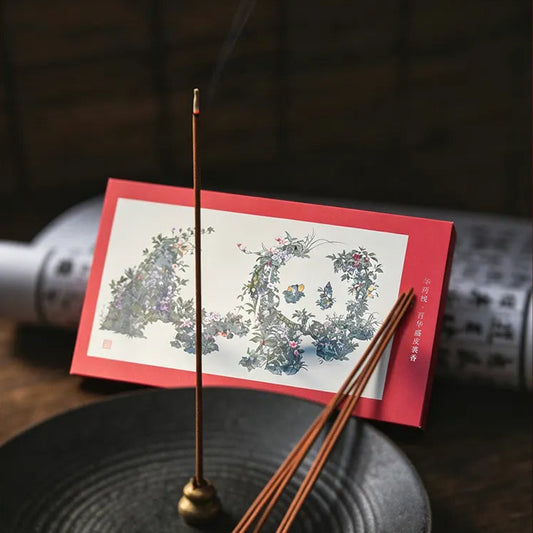
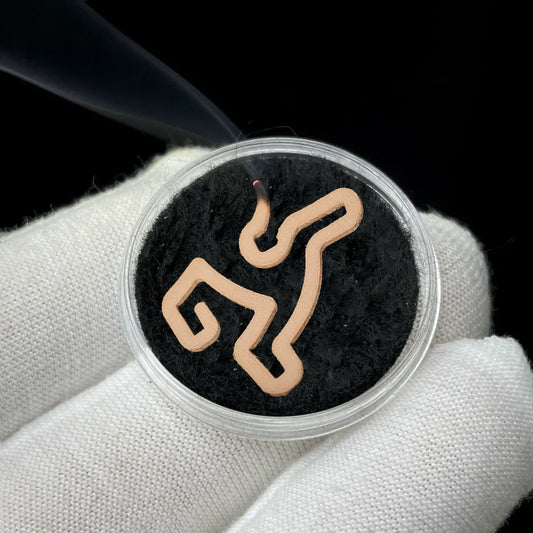
Here is where the incense comes in, as the timer. Light a stick when your feet go in. Chinese incense has 1,500 years of history as a timekeeping device, and a standard stick burns for roughly 30 to 45 minutes. That is longer than the soak, so when the stick is about a third gone, your 20 minutes are up. We wrote a whole piece about how incense was used as a clock, and this is the most pleasant way we know to put that history to work.
The point of the stick is not therapy. It gives the ritual a beginning and an end that you can smell, and it stops you from checking your phone for the time.
Ritual 2: Keep the core covered
In TCM's framing, the lower back and abdomen are where yang resides. The advice that follows is simple. Keep the belly, the lower back, and the feet warm, especially during your period and in air conditioning. That advice lands remarkably close to what a physical therapist would tell you.
Heat is also one of the few comfort measures for cramping that has mainstream medical backing. Heating pads and hot water bottles on the lower abdomen are standard non-drug suggestions, and they are commonly recommended for endometriosis discomfort as well.
The practical version: high-waisted warm layers, socks on hard floors, and a hot water bottle against the lower abdomen in the evening. One step most people skip is covering the back of the waist, not just the front.
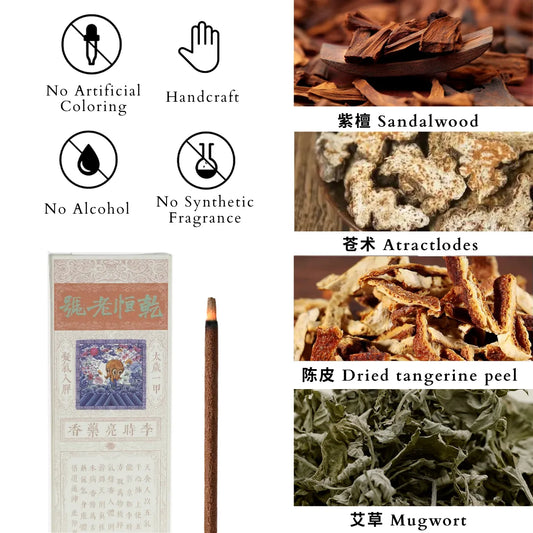
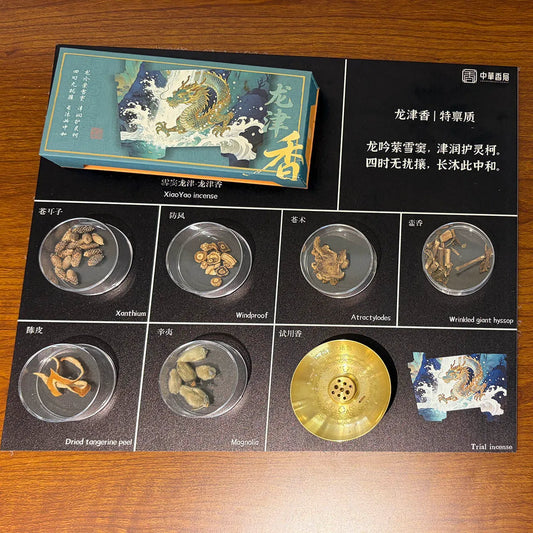
For the daytime version of the same idea, we built Xu Yang incense (Sun Warmth). It is the stick we made around the warming herbs themselves: cinnamon bark, clove, mugwort leaf, and dried ginger, softened with benzoin and ling ling xiang. Cinnamon bark, clove, and mugwort leaf are the same warming herbs that turn up again and again in the classical formulas, and they are in the stick for exactly that reason.
What it does is a different job from the heating pad. A heating pad warms one square of your belly. This one changes the air in the whole room, which is the thing a heating pad cannot do. Light it at your desk on a cold afternoon. On the first day or two of your cycle, light it while you are setting up the heating pad, the warm drink, and the blanket, so the room already feels like care before you lie down.
Ritual 3: Eat and drink warm
TCM's dietary guidance for cold patterns is straightforward. Favor cooked, warm, gently spiced food. Go easy on iced drinks and raw, cold foods, especially around menstruation. The warming ingredients it points to are kitchen staples:
- Ginger. Fresh in cooking, or sliced into hot water.
- Cinnamon. In oatmeal, coffee, or stewed fruit.
- Red dates (jujubes) and longan. Simmered into teas, a classic Chinese pairing.
- Lamb, beef, leeks, walnuts. The traditionally warming foods for deficiency-cold patterns.
(Sources: People's Daily Online health channel; National TCM knowledge base.)
Warming foods are a TCM classification, not a clinical category. Warm food and warm drinks are still pleasant, cheap, and harmless. Swapping your third iced coffee of the day for ginger tea is a change you will feel on a cold morning, no matter which framework you prefer.
Ritual 4: The wind-down hour
TCM holds that yang retreats inward at night, and that staying up late scatters it. That is its own version of a very modern observation. Sleep debt makes everything harder, including how strongly you feel pain. Whichever framework you prefer, the practical advice is the same. Protect the last hour of the day.
This is the ritual where scent does structural work. A stick of incense at the start of the wind-down hour becomes a cue. The room smells different, so the wind-down has visibly begun, for you and for everyone else in the house.
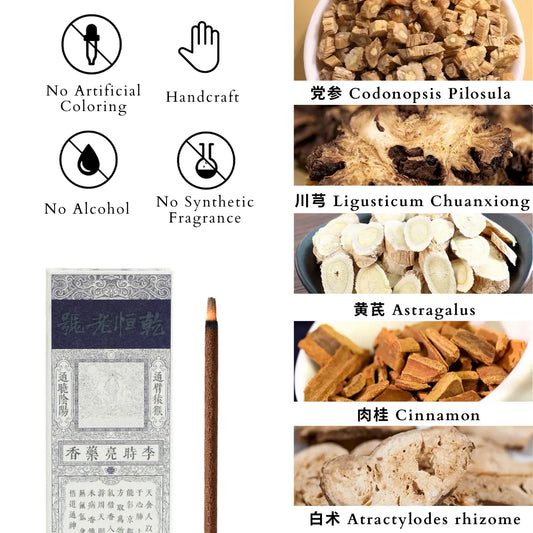
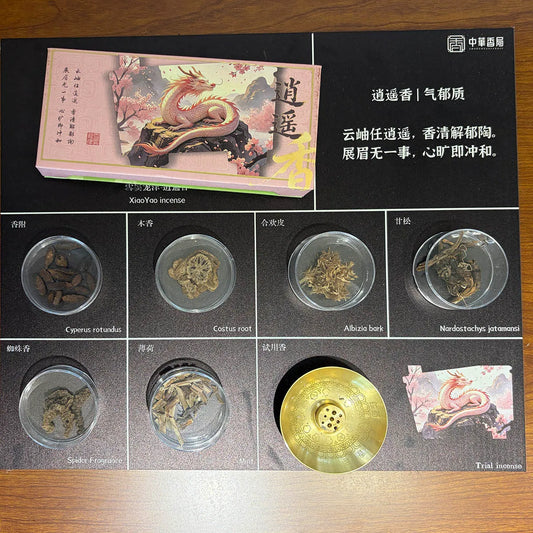
For the coldest nights we set one blend aside for this hour. Xi Chong incense is a warm spice stick built on cliff cypress and costus root, and it is the one we reach for when the hands will not warm up and the evening is going nowhere. It burns slow and even, with no bamboo core racing the ember along. A stick is roughly the shape of half an hour, which is exactly the shape of a good wind-down.
It was blended for the nights when you feel cold from the inside out. For a lot of women that means the first two nights of the cycle, and those are the nights we had in mind when we made it.
If you would rather start with the house blend, our standard sticks are 合香, blended from Chinese aromatic botanicals, and they keep the same slow, even burn.
The sequence goes like this. Soak your feet, pull on warm socks, dim the lights, light the stick, then settle in with tea or a book and leave the phone beside. By the time the stick is down to its last inch, you will be ready to follow it.
Ritual 5: Warmth you can wear
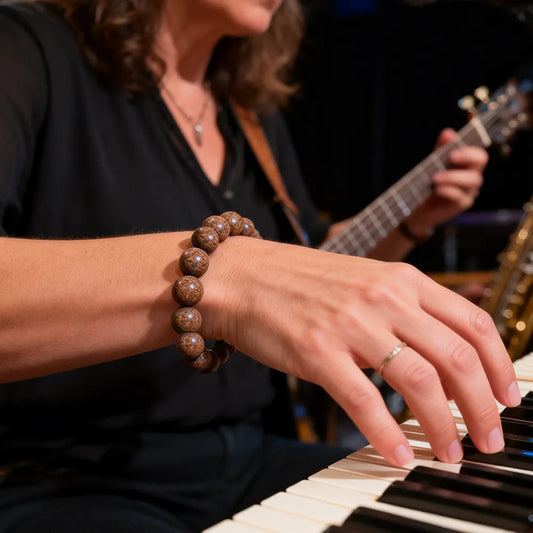
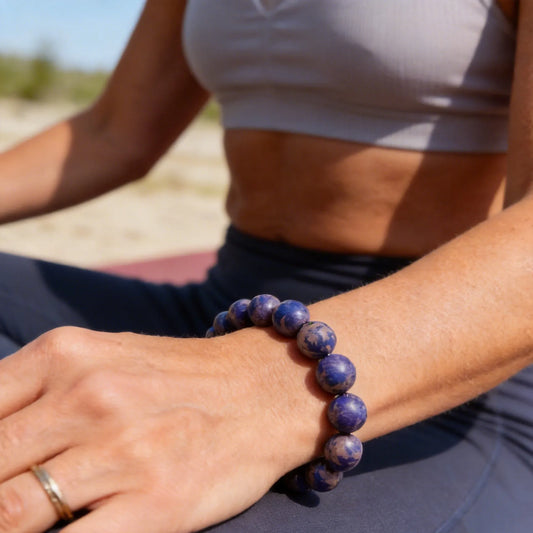
No ritual can happen at home all the time. A bracelet of wearable incense beads, blended and hand-finished in the Chinese tradition, is the portable version. The botanicals are chosen for their scent, and the beads sit at the pulse point where you catch them all day. People have worn fragrant woods and herbs on the wrist for this exact reason for well over a thousand years, from Han dynasty boudoirs to the medicine beads still made today.
It is a comfort object and a scent ritual. What it carries is the smell of the evening ritual, so a cold afternoon at your desk has something of the evening in it.
There is still a real use for one small thing that smells like the version of you who got through the evening ritual. It rides along on the cold bus, in a freezing office, and on day one of your cycle, when you need the reminder that the hard part has an end.
When warmth is not the whole answer
Everything above is daily care, and daily care has limits. Here are the two situations where the right next step is a professional rather than another warm sock. Both are worth knowing once.
Cold hands and feet that never warm up
Most people with cold hands and feet are simply people with cold hands and feet. Hands and feet sit farthest from the heart and carry very little muscle to generate heat, so they cool down first. That is normal. What is worth a checkup is cold that never goes away, because the two most common causes are easy to treat once found. Anemia, which is common in women who bleed heavily, and an underactive thyroid both show up on a simple blood test. The third is Raynaud's syndrome: fingers that turn white, then purple or blue, then red as they rewarm, or one hand or foot that runs much colder than the other. If you are always cold and always tired, rule the first two out before you blame your constitution.
(Source: Ohio State University Wexner Medical Center.)
When women's cramps deserve a gynecologist, not just a heating pad
Painful period cramps are common. Mild cramping for a day or two is a normal response to prostaglandins, the compounds that make the uterus contract. What is not normal is extreme pain during menstruation, the kind that takes over your day and shrugs off everything you have already tried. The American College of Obstetricians and Gynecologists (ACOG) is explicit about the signs that mean women period pain needs an evaluation:
- It regularly makes you miss work, school, or plans.
- It is not adequately controlled by over-the-counter NSAIDs taken as directed.
- It gets worse year over year, instead of easing.
- It happens outside your period, such as mid-cycle, during sex, or with bowel movements.
- It comes with heavy bleeding, meaning you soak through protection or pass large clots.
Period pain that worsens over time follows the classic pattern of secondary dysmenorrhea. That term simply means period pain caused by a condition underneath, such as endometriosis, fibroids, or adenomyosis. Endometriosis affects roughly 1 in 10 women of reproductive age, and it is also one of the most common causes of infertility. That is one more reason to raise severe period pain and trouble conceiving in the same visit.
If that description fits your first two days, the most useful self-care decision available to you is an appointment.
If you're trying to conceive
If you have been trying for 12 months, or 6 months if you are 35 or older, without conceiving, standard guidance is to see a reproductive specialist instead of waiting longer. If your periods are severely painful, mention that at the same visit. Conditions like endometriosis connect the two problems, and one appointment can cover both.
(This 12 and 6 month convention follows widely published fertility medicine guidance. Confirm the specifics with your own doctor.)
What Chinese medicine traditionally advises in this window is warmth in the lower abdomen, warm cooked foods, adequate sleep, and a lighter hand with cold and raw foods. All of it sits comfortably alongside medical care, and it is a reasonable thing to discuss with a licensed TCM practitioner.
What it should never replace is testing. Irregular cycles, known or suspected endometriosis, thyroid issues, and male factor causes all need real evaluation, and many causes of infertility are very treatable once identified.
If you are trying to conceive, or you are in fertility treatment, tell your doctor about any herbal supplement you take. Herb and drug interactions are real, and this is the one place in this article where getting it wrong matters most.
FAQs
What helps women's cramps fast at home?
Heat comes first. For painful period cramps, a heating pad or hot water bottle on the lower abdomen is one of the standard comfort measures doctors recommend, and it is commonly suggested for endometriosis discomfort too. Gentle walking, light stretching, a warm drink, and real rest all help as well.
For most women, the best-studied period relief is an over-the-counter NSAID taken early, at the first sign of cramping. Whether or how to use one is a question for your doctor or pharmacist. And if cramps regularly stop you from working or living normally, that is the signal to book the gynecologist appointment.
Does extreme pain during menstruation mean something is wrong?
Not always, but it is worth checking. Regular cramping on the first day or two is normal, and it eases as prostaglandin levels drop. Extreme pain during menstruation that keeps you home, worsens over the years, or does not respond to over-the-counter relief points to secondary dysmenorrhea, which means period pain with a condition underneath. Endometriosis is the most common one, and it affects about 1 in 10 women of reproductive age. An exam and an ultrasound are usually where the conversation starts.
Is a "cold uterus" (宫寒) a real diagnosis?
No modern medical test can diagnose a cold uterus. It is a folk label. The closer traditional terms are 寒凝胞宫 (cold congealing in the uterus) and 胞宫虚寒 (deficiency cold of the uterus). Telling them apart requires a proper TCM consultation.
Does a warm foot soak really help you sleep?
The mechanism is real. Warming the feet dilates the blood vessels in the skin, heat radiates out from the core, and the falling core temperature is one of the body's strongest sleep signals. That is the finding behind the Nature study cited above, and follow-up trials put practical numbers on it: about 40 °C water, 10 to 20 minutes, finished one to two hours before bed. What the soak is not is a treatment for anything. It is temperature physics and a good wind-down cue.
Do warming foods actually do anything?
Warming is a traditional classification, not a clinical one. The advice underneath, which is to favor cooked warm food over iced drinks, is cheap, pleasant, and harmless. A hot ginger tea on a cold morning does something no framework needs to justify.
The first days, and the other days
The first two days belong to whatever brings period relief: painkillers, prescribed care, a heating pad, and rest, with no apology. Nobody should guilt you out of an ibuprofen. What a warm ritual can add to those days is smaller and more honest than a cure. A room that already smells like care. A reason to lie down for half an hour. Something to reach for that is not a screen.
Then there are the other twenty-six, and those are the ones you can actually build on. Feet warm before bed, core covered, food and drink warm, sleep defended, and one small scented ritual that marks the day as taken care of. Do them long enough and they stop being tasks. They become the way your evenings simply go.
Shop the ritual: Xu Yang incense | Xi Chong | standard sticks | incense bead bracelets
A note on burning safely
Never leave a burning stick unattended. Use a holder that catches ash, on a surface that will not scorch, away from curtains, paper, pets, and kids, and give the room some air.