Why Fresh Cut Grass and Old Books Smell So Good
Share
Everybody has a smell they will stop for. Fresh cut grass on a Saturday morning. A carpentry shop. The inside of a secondhand bookstore. Why that one, when a hundred other smells go past you without registering?
Chinese medicine answered that question a long time ago. It answered by sorting smells into five families, and the biggest family is called 木, Wood. It holds every plant that grows, right down to the plants we mash into paper.
If the smell you stop for is green, or woody, or resinous, or if it is the smell of an old bookstore, you are standing in this Wood element. If you want the wide view first, that one is here.
What the Wood Element Actually Covers
Walk outside and everything green is in this family, such as the lawn, the hedge, the oak bark, the pine sap, a stack of paper and the smell of a bookshelf. From《素问·金匮乏真言》, there is a sentence, 東方青色,入通於肝……其類草木, which filed all of it under the name of 草木 (grass and trees).
In traditional Chinese medicine, the Wood element connects to the liver. However, the liver has a smell of its own, and it is not grass. It is 臊 (a raw, gamy smell), closer to a butcher's counter than to a garden.
Inside the family there are three kinds of material, and they do not burn the same way. Leaves and grass. Wood and bark. Resin.
Grass, Wood, and Resin
Why fresh cut grass smells so good
When a mower crosses a lawn, the blade breaks cells open along every leaf it touches. Enzymes already sitting in those cells begin on the fats in the membranes and produce six-carbon aldehydes within seconds. The main one is cis-3-hexenal, and the human nose catches it at roughly 0.25 parts per billion, which is why one mown lawn can scent a whole street.
The grass is not doing this for us. Green leaf volatiles are the standard plant alarm, and Matsui's review of the pathway describes them as signals used within and between plants, and as a way for the organisms around a plant to recognize one another. Every green thing you crush runs a version of it, basil and lettuce and a snapped bean. What reaches you as summer, the plant is broadcasting as damage.
Why we enjoy it is a separate question. The usual explanation is that the memory part. For most people who grew up near a lawn, cut grass smells like being nine years old.
The old system files all of it under the name of 草木 (grass and trees). What wood does to qi, the force this system says moves through the body, is 疏泄. In English that is usually free flow and dispersion, and the plain version is this: wood is the phase that keeps things moving instead of letting them pile up. That is a job, not a substance.
Where "aromatic opening" comes from
You may have met the phrase 芳香开窍 (aromatic opening) in Chinese medical writing. The official English translation is resuscitation with aromatics. It is a real treatment category, with a set member list. For example, the warming branch of the formulas that wake a person up. The classical materials in it are 麝香, 苏合香, 石菖蒲 and 冰片. The formula everyone points to is 苏合香丸, from 《太平惠民和剂局方》, a Song dynasty pharmacy manual. The category was built for emergencies. It is for 神昏, the state where a person has lost consciousness.
For the link between fragrance and movement the tradition leans on a different line. 陈自明, a surgeon writing in the 1200s, put it in his 外科精要: "气血闻香则行,闻臭则逆" (When qi and blood meet something fragrant, they move. When they meet something foul, they turn back). He was writing about wound care, and he filed fragrance with food, as one of the things that keeps a body in order.
Why resin carries more than grass
A stick smells like whatever is in it, and these three materials are not equals. Leaves and grass are mostly water and fiber, so there is very little in them that can rise off as scent. Wood is denser and gives its smell up slowly. Resin is where the tree keeps the concentrated version, which is why a resinous blend sits heavier in a room, and why agarwood is the heaviest thing in this family.
Agarwood is not ordinary wood. It is what a tree makes after it gets hurt. An Aquilaria tree takes damage, and over years it floods the wounded wood with resin. That is why the smell reads deep instead of green.
Which channel agarwood enters depends on which book you open. The channels are the body's internal pathways in this system, and 缪希雍's 《神农本草经疏》 lists five of them, the last being the liver: "足阳明、太阴、少阴,兼入手少阴、足厥阴经". 《本草经解》 gives the gallbladder, the liver and the lung. The pharmacopoeia in use today files the same plant under the spleen, the stomach and the kidney. Three books, three answers, one plant. This is a tradition that works by commentary.
The blends we make with agarwood are in our agarwood collection.
Paper, Tissues, Nails, and When a Craving Means Something
Why old books smell good
In 2009 a team at University College London measured what seventy-two old books were giving off, and published the result in Analytical Chemistry. Their own sentence about it is the best anyone has written on the subject: "a combination of grassy notes with a tang of acids and a hint of vanilla over an underlying mustiness."
Grassy notes, in a book. Paper is plant fiber. As it ages, the lignin in it, the stuff in wood that holds the fibers together, breaks down into molecules close to vanillin, and that is your vanilla. The acid tang and the mustiness come from the other few hundred compounds leaving the paper all at once. Books printed after about 1850 age faster, because wood pulp and a rosin coating turned the paper acidic.
Set the old book next to the cut lawn and you find both of them are under 草木 in old system.
Why do you want to eat paper?
Wanting to smell paper and wanting to eat it are two different things. The second one has a medical name. Pica is the term for eating things that are not food, and paper is the textbook example, whether it is paper towels, tissues, or sheets of paper. MedlinePlus names the usual cause: "a lack of certain nutrients, such as iron and zinc, may trigger the unusual cravings." The MSD Manual adds pregnancy and iron-deficiency anemia, and notes that pica causes problems of its own, including blocked intestines and lead exposure from printed ink. If this is you, or a child in your family, do one blood test.
Nail biting and the liver
The nails sit in the liver's column, and the classical line is short. 《素问·六节藏象论》: "肝者,罢极之本,魂之居也……其华在爪". The liver's shine shows in the nails. It is the same kind of statement as 其类草木: a thing placed in a group.
Medicine has studied nail biting for a long time. It has a name, onychophagia, and DSM-5, the manual doctors use to classify these conditions, lists it with the body-focused repetitive behaviors, the group that covers hair pulling and skin picking. A 2022 review in the International Journal of Environmental Research and Public Health calls it "relatively common in the general population, particularly in children and individuals under stress", and puts it at 20 to 30 percent of people, rising to about 45 percent between age 10 and the teen years.
Both systems noticed the same thing. What they do with it is different. Filing the nails under the liver gives you a way to think about them. If it is a habit you cannot stop, or it is your child's, the next step is a doctor.
Does Wanting a Smell Mean Your Body Needs It?
Here the tradition makes its biggest claim. A body out of balance reaches for the smell that answers to it. Want a scent, and the scent is telling you what you need. 陈自明's line about fragrance and qi comes from that same way of thinking, and it is written down in a medical text.
The science of smell says something else. What you like is set early, by what you smelled first. Smell memory lasts an unusually long time and refuses to show up on command. The same smell can read differently depending on what your nose learned to expect. Rachel Herz's work on smell and memory is the standard citation, and it explains why one smell carries one person back and leaves the next one cold. If you want the mechanism itself, that is here.
How to Choose by the Smell You Already Like
You have been smelling things your whole life, so you already know which family you belong to. The rest is finding incense with the same note.
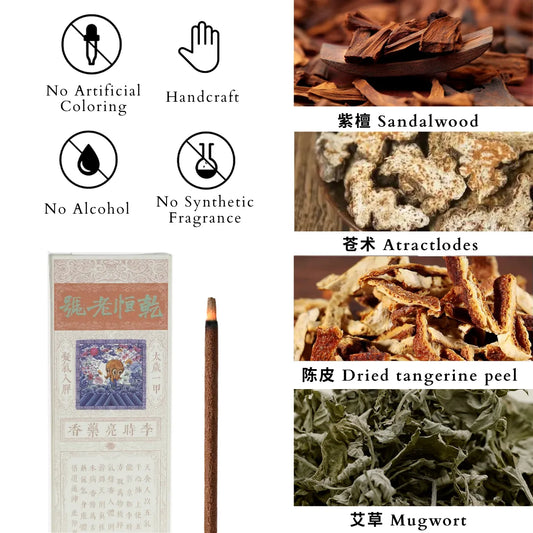
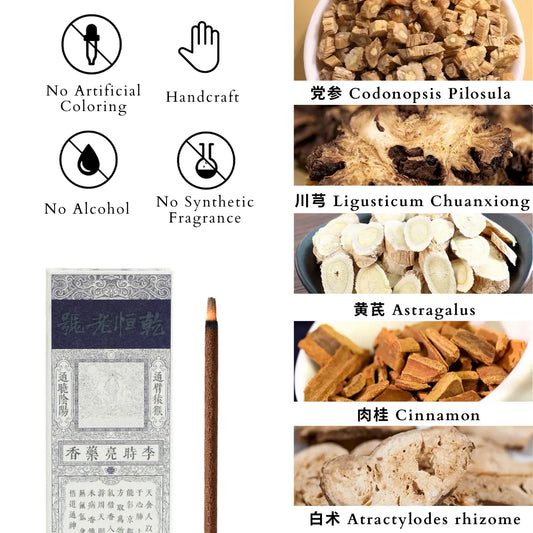
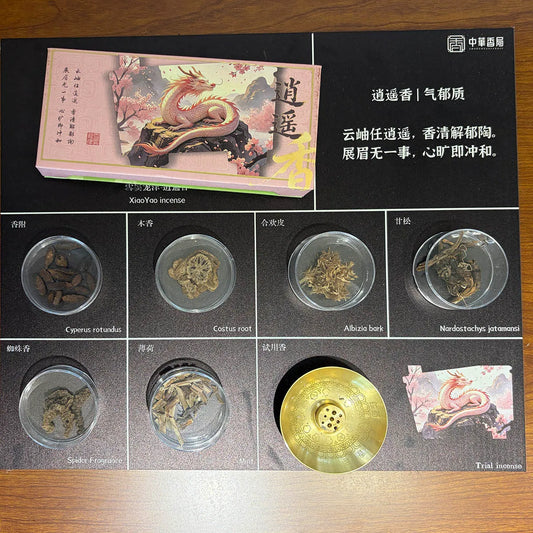
- If it is grass and wood. Xi Chong incense blends cliff cypress with costus root. The aroma is dry, woody, faintly bitter, closer to a carpenter's bench than to a garden. Qiong Qi incense sets cliff cypress with Chuanxiong and atractylodes for the days you spend at a desk. Both are in the Shan Hai collection.
- If it is resin. Our agarwood incense blends are in the agarwood collection, and the sandalwood side, which reads creamier and less bitter, is in sandalwood.
- If it is flowers. Mid-Autumn incense blends Osmanthus, and Osmanthus is the one floral note I will name as a traditional Chinese perfume material.
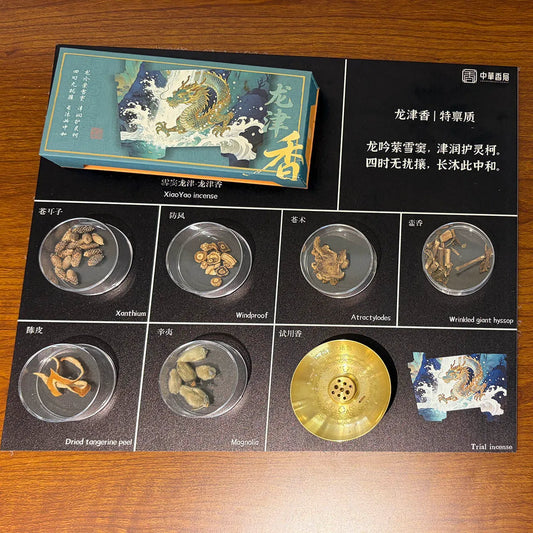
- If it is warm and dry. Xu Yang incense runs cinnamon, clove, mugwort leaf, dried ginger, and benzoin, and it is the one I burn on the first cold night of the year. That line is the Xuedou Dragon Stream collection.
One last practical note. The blend has to be one you enjoy smelling, because you are the one sitting in the room with it. Everything else is a detail.