The Fall Incense Guide: 4 Chinese Herbal Blends for ragweed Season, Smoker's Throat, and Stuffy-Sinus Evenings
Short on time? Here's the answer.
|
If this is you… |
Start with |
|
Your throat feels like sandpaper by 3 p.m., or you're a smoker whose cough wakes up every October |
Huan Mao Incense is built for dry, scratchy throats and smoker's airways |
|
You sneeze at the same open window every September, and your nose is blocked by 8 p.m. |
Tian Gou Incense is formulated for seasonal nasal misery and heavy, blocked breathing |
|
You check the AQI app before leaving the house, or you live near traffic, farmland, or wildfire-smoke drift |
Qing Geng Incense is designed for people who live where the air isn't kind |
|
You've taken a TCM constitution quiz and scored high on "special diathesis" — or your allergies have always been… different |
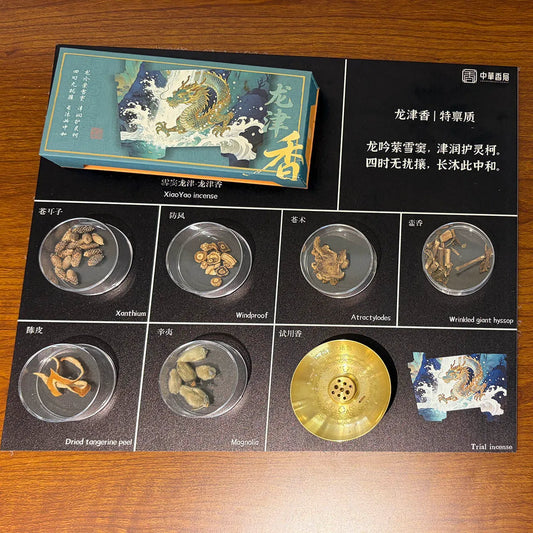
Long Jin Incense is built around Traditional Chinese Medicine's nine--body-constitution framework for the allergy-prone constitution |
Now, why these four? Here is why fall is the season that actually corners your body, and what a Chinese herbal incense tradition has to say about it.
Why your body struggles in Fall
Spring gets all the allergy attention. Fall is the season with the worse math.
Start with pollen. Ragweed is the main culprit behind autumn allergies, and according to the American Academy of Allergy, Asthma & Immunology, a single ragweed plant can produce up to 1 billion pollen grains in one season. The grains are light enough to travel as far as 400 miles on wind, which is why living downtown saves you from almost none of it. The AAAAI also notes the season itself has stretched: what used to run mid-August through September now starts earlier and hangs on into October as temperatures climb.
Then the windows shut. The U.S. EPA estimates Americans spend about 90% of their time indoors, where concentrations of some pollutants run 2 to 5 times higher than typical outdoor levels. Forced-air heating dries the apartment out right as leaf litter feeds mold spores outside. The room you sealed for warmth becomes the room your throat and nose have to negotiate with until spring.
The scale is not small. CDC survey data puts seasonal allergies at about 25.7% of U.S. adults, more than 1 in 4. And the AAAAI reports that roughly 80% of seasonal allergy sufferers also struggle with sleep, which is how "tired and stuffy" quietly becomes a personality every October.
So you are not being dramatic. Antihistamines are real and they work. What American allergy shelves don't have is the category Chinese households have kept for centuries: Yao Xiang (药香), incense blended around specific herbs for specific situations and seasons. A blend you light on purpose, for the room you're actually sitting in, for the weeks you're actually living through. That's a different job than a candle, and a completely different job than a pill.
Here's how to match one to your October this year.
1. Huan Mao incense sticks: for the scratchy throat and the smoker's October cough
The scenario. It starts as a tickle around the night the heat comes on. By afternoon your throat is dry and scratchy no matter how much water you drink. If you smoke, or used to, you know the upgraded version. The cough that quietly leaves town in June and moves back in every fall, settling into your chest by the time the clocks change. This one is genuinely environmental. Forced-air heating drops indoor humidity exactly when your throat is already dealing with ragweed season, so the dryness is not your imagination; it is the room.
The spirit. Huan Mao is named for a creature from the Shan Hai Jing, the two-thousand-year-old Chinese classic of mountains and seas: a wildcat with one eye and three tails, whose voice was said to drown out a hundred others. The books say it warded off danger. We kept the loudness and left the rest in the mountains.
The formula. The stick itself is a multi-ingredient blend and includes four key botanicals: cliff cypress for a dry, resinous wood base; white atractylodes and poria, two roots the Chinese pharmacopoeia has paired for over a thousand years; and licorice, which Chinese herbalism classifies as the great harmonizer, the ingredient that softens everything it travels with. The scent reads like old floorboards, dry roots, and a thread of licorice sweetness. In the Yao Xiang tradition this is an autumn-winter profile: a warm, grounded room rather than a perfume.
How to use it. One Huan Mao incense stick in the evening, in the room where you actually spend your evening, window cracked an inch. Treat it as a thirty-minute ritual while you read or wind down, not a room-wide fog.
One honest reminder: a cough that hangs around for weeks deserves a doctor, not a fragrance. We would rather you be well than polite about it.
2. Tian Gou incense sticks: for the September nose that arrives on schedule
The scenario. You know your window. Mid-September, the trees turn, and one morning your nose blocks up and your eyes water while you're still finding the coffee. Allergists even track the spike around back-to-school season, driven partly by ragweed's peak. By evening you're mouth-breathing through a series. Your partner asks if you're crying. You're not. It's ragweed.
The spirit. Tian Gou is another western-mountain beast from the Shan Hai Jing: a wildcat with a white head, whose cry was said to carry clear through fog. The mountain people in that tradition believed it always knew which path was open. Where the white-headed one walks, the haze lifts. That image, a clear morning after a heavy week, is the whole idea of this stick.
The formula follows the Chinese herbal tradition's approach to the sealed-up season: cliff cypress again as the cold, clean wood note, with fritillary bulb, Solomon's seal, lily bulb and figwort root, the cool and moistening herbs the tradition reserved for dry autumn air. The scent opens sharp and cedar-like, then settles into a soft lily sweetness.
The honest science. Here's something most incense articles skip: when aromatic compounds like menthol hit your nose, they stimulate the same cold receptors that respond to ice, and that stimulation produces a genuine sensation of freer airflow. The "ahh, I can breathe" feeling is real. It is also a sensation, not a mechanism. An incense stick is not an antihistamine, it does not reduce the histamine response driving your September, and any brand that implies otherwise is hoping you don't know the difference. What a blend like this offers is the sensation, the ritual, and a room that feels different to walk into.
How to use it. Morning or wind-down, in a ventilated room. The small ceremony of lighting it, one match and one deliberate act, is half the point: a signal to your body that the day is starting or ending.
3. Qing Geng incense sticks: for people who live where the air isn't kind
The scenario. You check the AQI app before you leave the house. You live near a highway, downwind of farmland, next to a construction site, or, increasingly common, in a city that catches weeks of wildfire-smoke drift from fires hundreds of miles away. You're also the person who catches whatever circulates through the office, every round, every year.
The spirit. Qing Geng is a bird from the same classic: blue-bodied with a white beak and white tail, and the old texts say its call could hold back the sickness that periodically emptied villages. Nobody knows what the ancients meant by that exactly, but the image survived two thousand years: a blue bird singing, and the bad season staying outside the walls. For the months when the whole city seems to be coughing, it's a durable image.
The recipe.The Qing Geng incense stick pairs green sandalwood with frankincense, spikenard and chuanxiong root. Frankincense is the familiar half; it's been burned in rooms people wanted to feel protected in since long before modern wellness discovered it, and it carries a crisp, church-adjacent resin profile American noses already know. Spikenard and chuanxiong are the Chinese half, earthy and rooted, the kind of materials you find in old He Xiang (合香) formulas rather than in a mall candle.
What we will not claim. What we offer instead is the oldest, most literal function of incense: scenting a room on purpose, marking it as yours, with materials a classical tradition specifically associated with the hard months of the year.
How to use it. In the entryway or living room when you get home, as a reset ritual after a day in traffic, offices, and everyone's germs. Pair it with one habit: open a window once a day, even in January. The two work well together.
4. Long Jin incense sticks: for the "special diathesis" constitution (yes, that's a real term)
The scenario. Your sensitivities have never really been seasonal. Random reactions, product intolerances other people don't have, a histamine system with a hair trigger. A doctor once shrugged at you. Standard advice doesn't quite fit, and you've noticed.
Here Traditional Chinese Medicine offers something genuinely specific. TCM's constitutional framework, formalized by Dr. Wang Qi and standardized in China, sorts people into nine body types measured by a 60-item questionnaire (the Constitution in Chinese Medicine Questionnaire, CCMQ). One of the nine is Te Bing Zhi (特禀质), the special diathesis constitution: the type marked by allergic tendencies, hypersensitivity to environmental change, and reactions others simply don't have. Population studies using the CCMQ put it at roughly 4 to 6% of screened adults, often inherited (CCMQ background and validation).
The interesting part is the treatment philosophy. Rather than chasing each symptom, the tradition works on the constitution itself, slowly, over months and years. There is clinical research behind the approach: a randomized controlled trial published in Trials found a constitution-matched Chinese herbal formula significantly improved allergic rhinitis symptoms and quality of life versus placebo (Trials, 2014). The framework, in other words, is not folklore with a chart. It's a formal system with instruments and trials behind it, even if Western medicine remains rightly skeptical of parts.
The blend. Long Jin incense is our constitution-focused blend, built for exactly this type in that tradition. The honest way to describe the job: a slow daily-ritual companion rather than a rescue inhaler. We won't claim it changes your constitution, and we'd side-eye anyone who did. The way tea drinkers tend a practice over years is the register to have in mind.
How to use it. Low and slow. A few sticks a week as part of an routine, and patience measured in seasons.
The section may skip: smoke, sensitive lungs, and honest answers
Yes, incense produces smoke. Incense smoke contains fine particulate matter and volatile compounds, and research links heavy, daily, poorly ventilated indoor burning with more respiratory symptoms, especially in people with asthma. Any incense brand that doesn't mention this is hoping you don't ask.
So here is the playbook if your airways are already unhappy this fall:
- Ventilation beats everything. A cracked window while burning changes the exposure math entirely. The bad combination is a stuffy room plus smoke; one stick plus moving air is a different situation.
- One stick, one room, done. These blends are designed as twenty-to-forty-minute rituals. An incense stick is a poor air freshener and a worse roommate if left smoldering all evening.
- Read the ingredients. Synthetic fragrance and chemical binders are the usual suspects behind smoke that irritates. Our sticks are made from pure recognizable botanicals with natural plant adhesive.
- If you have asthma or COPD, talk to your doctor first. Treat incense as an occasional pleasure rather than a daily habit, burn low-smoke incense, or skip combustion entirely: a warmer or incense bracelet with the same herbal materials gets you most of the ritual with far less smoke.
A ten-minute fall evening ritual (free, steals well)
If you take one thing from this guide, take the structure:
- Open one window an inch. Yes, even in October. Your indoor air needs it more than you think.
- Light one stick matched to tonight's actual complaint: throat, nose, bad air, or just "long day."
- Put the phone down for the length of the stick.
- When it finishes, close the window and go to bed before the second wind arrives.
Remember the AAAAI's sleep figure. When four out of five allergy sufferers are losing sleep, a nightly downshift ritual is the cheapest intervention on this entire page.
FAQ
Does incense actually help with allergies?
What a purpose-blended herbal incense offers is real sensory relief (aromatics genuinely change how breathing feels), a room that feels different to walk into, and a nightly ritual with a two-thousand-year paper trail. Medical treatment and our incense are neighbors, never substitutes.
Which blend should I try first?
Match your loudest complaint: throat with Huan Mao; nose with Tian Gou; environment with Qing Geng; constitution with Long Jin. If several sound like you, start with the one tied to the room you spend your evening in.
Is incense safe if I have asthma?
With ventilation and occasional use, many people do fine, but asthma is not a "most people" condition. Talk to your doctor, and read the smoke section above before your first burn. We would rather sell you one tin a year honestly than a drawer full of ignored sticks.
Why are some incense named after mythical beasts?
Three of them come from the Shan Hai Jing, the ancient Chinese compendium of mountains, seas, and the creatures living in them, the same tradition Chinese medicinal incense grew out of. A one-eyed cat, a white-headed beast and a bird that sang the bad season away. The names point back to where the craft comes from rather than dressing up a candle.
Explore the collection: Huan Mao incense · Tian Gou incense · Qing Geng incense · Long Jin incense, each hand-blended in small batches by Panda Incense.