Computer Headache: Why Long Screen Days End in a Headache
Share
Do you spend most of your day in front of a screen, and partway through it your head feels heavy and your temples are tight, enough that you have to stop? A computer headache like that is rarely random. Most of the time it is several small things stacking on each other, which is why the fixes are small and repeatable as well.
Why six hours at a screen turns into a headache
Your neck holds one position for hours
When you look at a screen, your head drifts forward and your shoulders round. Clinical reviews describe the result plainly. A neck that stays flexed for long stretches puts extra stress on the upper cervical joints, so the muscles at the back of the neck take the load continuously. Some of them tighten, and the pattern they produce is the most common headache there is.
Tension-type headache is the most common primary headache disorder. Reviews put its worldwide lifetime prevalence at 46 to 78 percent (StatPearls, National Center for Biotechnology Information). Among female office workers, studies have found that tenderness in the trapezius, the big muscle between neck and shoulder, tracks with how intense the headaches are and how many days a month they happen.
Two things at your desk make this worse. A screen placed too low makes you look down all day. A laptop without a riser does the same thing, because the keyboard pulls the screen below eye level. Optometrists recommend putting the top of the screen no higher than eye level, tilted back slightly.
Your eyes hold one focus for hours
Digital eye strain is what optometrists call the cluster of problems that follows prolonged screen use. Two mechanics are behind it.
First, blinking drops. People normally blink about 15 times a minute. At a screen it falls to roughly 5 to 7 (American Academy of Ophthalmology). Fewer blinks means the tear film dries faster, and dry eyes feel like grit and burning.
Second, your eyes stay locked at one short distance. The muscles that focus the lens hold a fixed position for hours, the way any muscle tires when it does not move.
The American Optometric Association puts people who spend two or more continuous hours a day at a screen at the greatest risk, and adds that uncorrected vision problems make symptoms worse.
When the dry surface and the tired focusing muscle stack up together, what people describe is an eye strain headache, usually felt behind the eyes and across the forehead.
The room has not had fresh air in hours
The United States Environmental Protection Agency lists headache among the symptoms people report in office buildings with inadequate ventilation. So does the same agency's materials on sick building syndrome, alongside fatigue, dizziness, and forgetfulness.
There is a second effect that is better measured. A Harvard and Syracuse study published in Environmental Health Perspectives put knowledge workers through normal workdays in a controlled office and changed the air. Compared with a well ventilated day at roughly 550 ppm of carbon dioxide, cognitive scores dropped about 15 percent at 945 ppm and about 50 percent at 1,400 ppm. Both are ordinary levels in real offices and meeting rooms.
Carbon dioxide at those levels is not poison. The point is different. Stale air is measured.
You are running on old water and a caffeine curve
Two habits do a lot of quiet damage on a long workday. The first is drinking less water than you think. The second is caffeine used unevenly, either three cups before noon or none at all after years of three cups.
Caffeine cuts both ways. The FDA cites 400 milligrams a day, about two to three cups of coffee, as an amount not generally associated with negative effects for most adults. Cut back abruptly and withdrawal includes headache, usually starting 12 to 24 hours later. Mayo Clinic's advice is to taper over several days to a week rather than stopping at once.
Skipping lunch belongs in this section too. Six hours on coffee and no food is a reliable way to end the afternoon badly.
The four fixes, in the order that helps fastest
1. Eyes first, every 20 minutes
The 20-20-20 rule from the American Optometric Association: every 20 minutes, take a 20 second break and look at something 20 feet away. Distance relaxes the focusing muscle. The pause also reminds you to blink properly. The AOA adds one more interval: a 15 minute break for every two hours at the screen.
2. Stand up every 50 minutes and move your neck
The problem is not sitting. It is sitting in one shape for hours. Three movements take under a minute.
- Chin tuck. Pull your head straight back as if making a double chin, hold five seconds, repeat ten times.
- Shoulder rolls. Ten slow circles backward, then ten forward.
- Doorway stretch. Put your forearms on the door frame at shoulder height, step through gently, and let your chest open for 20 seconds.
3. Change the air once an hour
Open the window, or step outside for two minutes. If your workspace has no window, walk to one. This is the fix people skip because it feels too simple to matter.
4. Stabilize the inputs
A water bottle within reach, a lunch away from the screen, and caffeine at a steady level rather than a spike and a crash.
Why does my head hurt after work even when I plan to take breaks?
Because a plan is not a break. The causes above all work on exposure time. Your neck holds one position, your eyes hold one distance, and the room holds its air, and none of it resets just because you decided to rest. Only time away from the desk brings it back down.
Most breaks fail in one of two ways. The first never starts. You set a reminder, it goes off, you swipe it away in half a second, and the paragraph you were going to stop after turns into three more. The second starts and then changes nothing. You stand up, and come back with a coffee in three minutes. Three minutes is not long enough to change what your eyes and your neck are doing, and then it is the same desk and the same posture for the next two hours.
Both failures have the same cause. You have to decide when the break ends, and you always decide too soon, because going back to work feels like progress and sitting still feels like nothing. That is the part an incense stick handles for you.
Where Qiong Qi incense fits
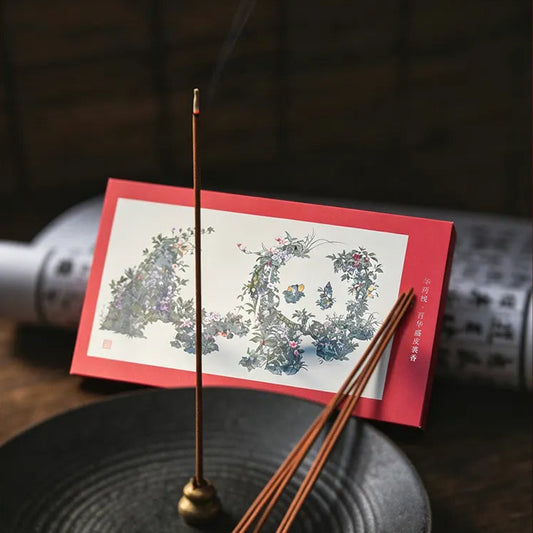
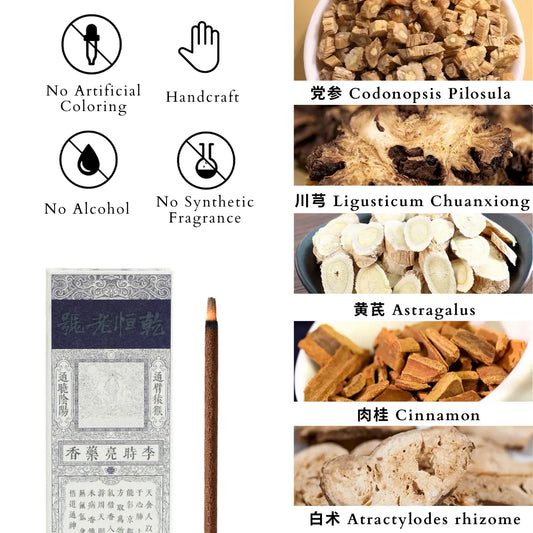
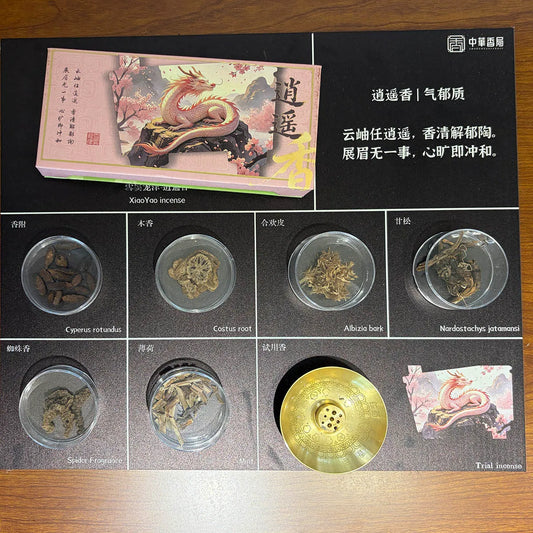
Qiong Qi is a creature from ancient legend and it eats people from their heads, so we use the spirit into incense stick. We formulate and blend with herbs especially for screen-heavy days. The key recipe includes Ya Bai (崖柏, cliff cypress), Chuan Xiong (川芎), and Bai Zhu (白术, white atractylodes). The smell is sharp and dry, more like cut cedar and herbs than like perfume.
The first minute is the good part. The smoke and aroma appear in your room, bringing fresh air. That is the most calming minute of the afternoon, and it is the only minute of one where you are doing one thing at a time. After that first minute it works as a clock, and there are two ways to run it.
While you work. If you work from home, this is the easiest it will ever be. Light one when a block starts and set it in a holder at the edge of the desk, then get back to what you were doing. A standard stick runs about 30 to 45 minutes, which is the length of a real work block. Somewhere in there the smell thins out, and then it is gone, and you notice the room has stopped smelling of it. That is the cue. The block has run its length, so stand up and leave the desk. Walk a slow lap around the room or down the hall. Roll your shoulders, drop your ear toward one shoulder and then the other, and let your eyes find the furthest thing you can see and stay there for a while.
While you rest. Light one the moment you stop, and stay in the room with it. Sit back or lie down and close your eyes, or walk towards the window and let your eyes travel around the room and watch outside. Window cracked. Let the stick run until it finishes. When it goes out, the break is over and the next block starts.
In a shared office you often cannot burn anything at all, so keep the habit for the first block after you get home.
Chinese incense has 1,600 years of history as a timekeeping device, and we wrote about how that worked. This is the most useful thing we know to do with that history. You can see Qiong Qi incense here, or explore our other incense sticks.
The herb that keeps appearing in old formulas for the head
One herb shows up in nearly every classical Chinese formula for head complaints. It is also in the stick above, and for a traceable reason: the tradition files it as a light, lifting, aromatic herb rather than a heavy one.
The oldest surviving Chinese materia medica, the Shennong Bencao Jing, was compiled in the Han dynasty. Its entry for chuanxiong (川芎) opens with the phrase 主中风入脑头痛, which describes the herb entering the head. Li Dongyuan, a physician of the Jin and Yuan dynasties, later wrote the line that is still quoted today: 头痛必用川芎, meaning that for head complaints, chuanxiong is always used. The Bencao Gangmu records it for the 少阳 and 厥阴 channel patterns.
The reasoning behind that tradition is in another Jin and Yuan text, the Lanshi Micang. 高巅之上,唯风可到. The summit is so high that only wind reaches it. That single image explains why these formulas lean on light, lifting, aromatic herbs rather than heavy ones. A Song dynasty verse collection, the Zhenzhu Nang Buyi Yaoxing Fu, describes what chuanxiong does in the body: 上行头角,助清阳之气,止痛;下行血海,养新生之血. It rises to the head to help the clear yang, and it descends to the blood.
The best known of those formulas is 川芎茶调散, from the Taiping Huimin Hejiju Fang, the Song dynasty state formulary. Chuanxiong is its chief herb, and the formula was used for head complaints that follow exposure to wind.
Those formulas were decoctions. They were swallowed, in gram doses, prescribed by a physician who had examined the patient. A stick of incense is burned and smelled.
When a headache is not a desk problem
Most headaches that follow a workday improve with the fixes above. Some do not, and the difference is worth knowing once.
Go to an emergency room or call 911 if a headache comes with any of these (Mayo Clinic):
- A sudden severe headache, the worst headache of your life, reaching full intensity within seconds or minutes.
- Confusion, fainting, or trouble speaking.
- Fever above 102 to 104 degrees Fahrenheit, or 39 to 40 Celsius.
- Numbness, weakness, or paralysis on one side of your body.
- A stiff neck.
- Trouble seeing, walking, or speaking.
- Nausea or vomiting that is not clearly from flu or a hangover.
Book an appointment if your headaches:
- Happen more often or are more severe than usual.
- Get worse, or do not improve with over-the-counter medicine used correctly.
- Keep you from working, sleeping, or living normally.
- Wake you from sleep, or are there when you wake up.
- Are new after age 50.
- Appear with coughing, sneezing, or exercise.
A headache that shows up on workdays and disappears on the weekend usually answers to the four fixes. The list above is for the ones that do not.
How to burn one properly
These blends open up in a space where the air moves a little, which is one more reason to keep the window habit. Still air flattens a blend, and a little movement lets the layers separate.
One stick at a time is the whole method. Two burning in one room and you stop being able to tell what you are smelling, and being able to tell is the entire point of He Xiang (合香).
The label carries two notes. Not for use during pregnancy or for children under three, and keep it away from anything that can catch. Never leave a burning stick unattended.
Quick answers
Why do I get a headache after looking at a screen all day?
Most screen-day headaches are not one problem, which is why no single fix clears them. A held posture, focusing muscles that never change distance, a room with no air exchange, and a broken eating and drinking rhythm all peak at the same point in the afternoon. None of them is a matter of willpower, which is why they respond well to fixed intervals instead.
Can sitting at a desk cause headaches?
Sustained poor posture with the neck flexed is a recognized contributor to tension-type headache. It is the usual explanation for a sitting at a desk headache. Clinical reviews point to upper cervical strain and continuous loading of the neck and shoulder muscles. It is about duration as much as position, so short breaks in posture matter more than a perfect chair.
How often should I take a break from my computer?
The American Optometric Association recommends the 20-20-20 rule, plus a 15 minute break for every two hours of screen work. For the neck and shoulders, standing up every 50 minutes is a workable rhythm. Tie the standing break to something physical, such as lighting a stick of incense and leaving it burning.
Does the 20-20-20 rule actually work?
Both the American Academy of Ophthalmology and the American Optometric Association recommend it. A 2023 clinical trial in the journal Contact Lens and Anterior Eye found that the rule reduced digital eye strain and dry eye symptoms in symptomatic computer users when it was delivered with automatic reminders. The reminder is doing real work there. Pick a method you will actually obey.
Why do I get a headache when I study?
The mechanisms are the same as a workday, and two of them get worse. Study sessions run longer without a formal break, and reading dense text at a fixed short distance with the head bent forward adds to the neck load. That is the short answer to a headache after studying for long hours.
Two groups know this better than anyone. Medical students and law students spend their days in long memorization blocks, where the volume is set by a syllabus and the material is dense by design. That kind of work punishes you for stopping, so the break is the first thing to go. Nobody decides to sit for five hours. It happens one more page at a time.
The desk advice still applies, and for a study headache it matters more than it does at a desk. A workday ends at a set hour. A study session ends when you decide it does. Screen or book at eye level, feet on the floor, and breaks on a schedule rather than on feeling. Two additions matter on a long reading day. First, change the distance your eyes are working at. Look across the room on a timer instead of waiting for your eyes to complain. Second, stand up once an hour, even if you sit straight back down in the same chair.
This is also why a study break needs a fixed length rather than a fixed intention. An intention of "a short break" turns into forty minutes on a phone. Half an hour with a clear start and a clear end is easier to keep, and easier to come back from.
Do calming scents actually do anything?
Two different things get bundled under that question, and they are worth separating. One is aroma as a treatment, where the evidence is thinner than the marketing suggests. The other is aroma as a cue, where the mechanism is easy to see. A repeated smell marks the end of a work block, and it does not depend on you noticing it. This page is about the second one.
The short version
Six hours at a screen is six hours of held positions: one neck angle, one focus distance, one breath of the same air. Fix those three things first, because they are free.
Then decide whether you want a smell that marks the end of a work block. That part is optional, and it is the part we make.